How to Prepare for the Qatar Prometric Exam: Study Plan, Syllabus & Tips
Learn how to prepare for the Qatar Prometric exam with a 30-day study plan, official exam blueprints, subject priorities, MCQ tips and mock-test strategies.
Updated By Reshma Abdul15 min read

On this page
On this page
Need help with your case? Talk to our documentation advisor on WhatsApp.
Chat on WhatsAppPreparing for the Qatar Prometric exam can be confusing, especially when you have to balance studying with hospital duties or a full-time job. You may already know the basics of your profession, but deciding what to study, which books to use, and how much time to spend on practice questions is often the harder part.
The Qatar Prometric exam is a computer-based qualifying examination administered by Prometric for Qatar's Department of Healthcare Professions (DHP), under the Ministry of Public Health. The subjects and passing requirements depend on your healthcare profession.
A good preparation plan starts with the correct exam blueprint. From there, you can decide which subjects need more attention, create a realistic study timetable, practise multiple-choice questions (MCQs), and use mock tests to check your progress.
This guide explains how to prepare for the Qatar Prometric exam, including a suggested 30-day study plan, official study references, profession-wise subject priorities, and practical exam preparation tips.
Key Takeaways
- Start with the official DHP blueprint. Your examination category determines the subjects, question distribution and passing requirements.
- Follow a realistic study plan. A 30-day timetable can help organise revision, but some candidates may need longer depending on their existing knowledge.
- Prioritise subjects according to the blueprint. Give more time to higher-weighted subjects and areas where you need improvement.
- Practise MCQs and timed mock tests. Focus on understanding correct answers, improving clinical reasoning and managing examination time.
- Track your progress. Maintain an error log, review weak subjects and use mock-test performance to assess readiness.
- Check official requirements before booking. Confirm your examination category, any applicable exemptions, and the current DHP and Prometric instructions.
How to Prepare for the Qatar Prometric Exam
To prepare for the Qatar Prometric exam, start by checking your examination category and downloading the official DHP blueprint. Use the blueprint to plan your studies, practise MCQs regularly, and take timed mock tests before your examination date.
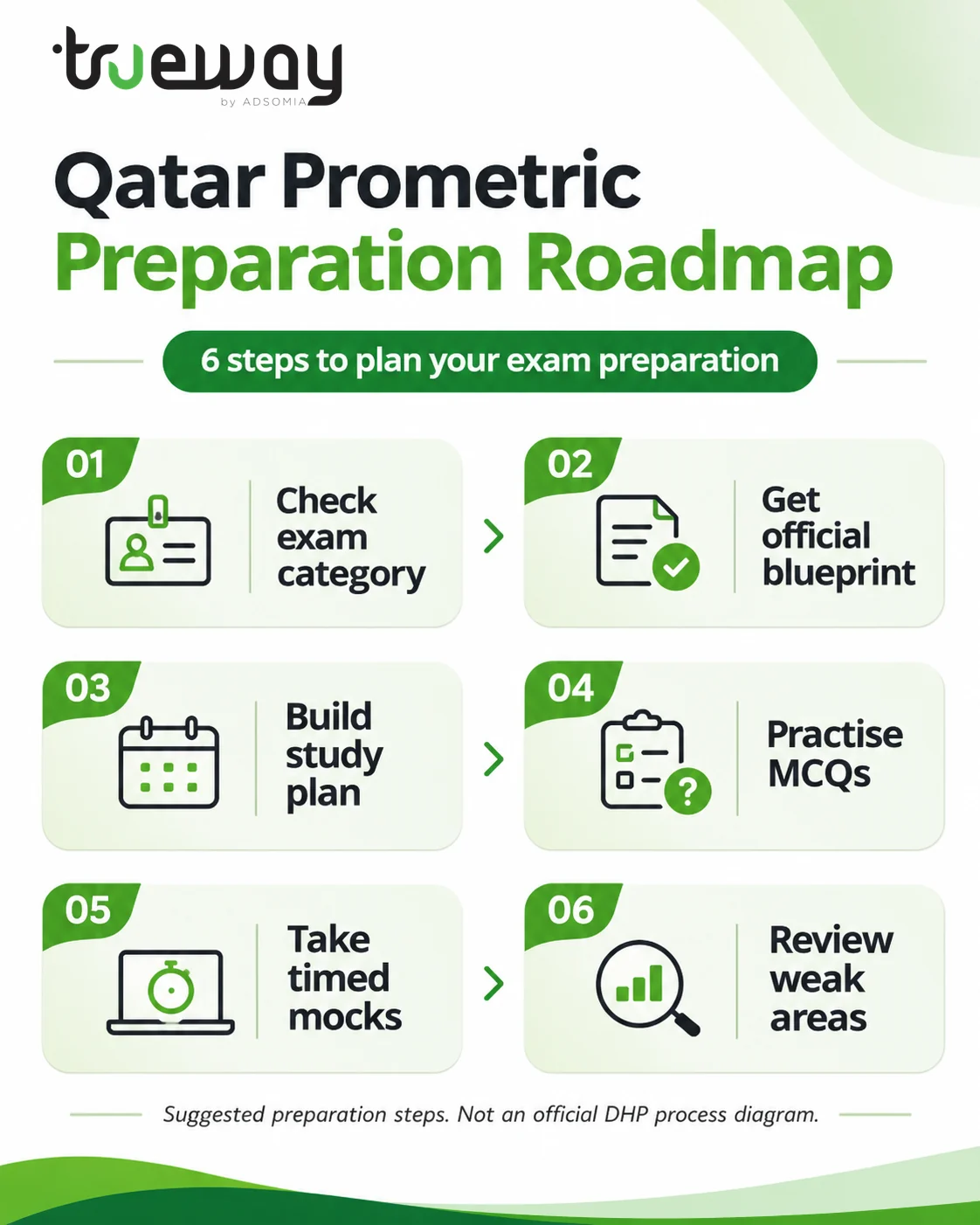
Follow these six steps to organise your preparation:
- Check your exam category. Confirm whether you are appearing as a registered general nurse, general practitioner, pharmacist, dentist, laboratory professional, physiotherapist, or another eligible healthcare professional.
- Get the official examination blueprint. Find the subjects, question distribution, passing score, and recommended references for your profession.
- Build a study plan. Divide the available preparation time between core subjects, MCQ practice, revision, and mock tests.
- Practise MCQs. Learn how to interpret questions, apply professional knowledge, and select the best answer.
- Take timed mock tests. Practise answering questions within the examination time and identify topics that need further revision.
- Review weak areas. Spend more time understanding incorrect answers and revisiting difficult subjects.
The preparation process should be different for every candidate. Someone who has recently completed their professional studies may need a different timetable from a healthcare professional returning to exam preparation after several years.
If you are still trying to understand the examination requirements, read our complete Qatar Prometric exam guide for healthcare professionals.
Understand Your Qatar Prometric Exam Pattern and Passing Score
Most healthcare categories listed on the current DHP qualifying examination page have 150 multiple-choice questions. However, the passing score and subject distribution vary by profession, so it is important to check the requirements for your examination category before starting preparation.
| Healthcare profession | Number of questions | Passing score |
|---|---|---|
| Registered General Nurse | 150 MCQs | 50% |
| General Practitioner | 150 MCQs | 60% |
| General Dentist | 150 MCQs | 60% |
| Pharmacist | 150 MCQs | 60% |
| Lab Technician | 150 MCQs | 50% |
| Physiotherapist | 150 MCQs | 50% |
Source: Qatar Department of Healthcare Professions, Qualifying Examination. Information checked on November 19, 2026.
Specialty examinations may have different passing scores. Do not assume the requirement for a general practitioner or registered nurse also applies to a specialist.
How long is the Qatar Prometric exam?
The DHP qualifying examination overview lists three hours for many 150-question examinations. However, linked profession-specific blueprints, including those for registered general nurses, general practitioners and pharmacists, specify 3½ hours.
Because these official documents differ, confirm the applicable duration in your latest examination blueprint and Prometric appointment instructions. This matters when practising timed mock tests, as your preparation should reflect the examination time applicable to your category.
Check whether you need the examination
Not every applicant will necessarily have to take the Qatar qualifying examination. Under DHP Circular 2025/19, dated November 26, 2025, certain qualifying examinations may support an exemption from the Qatar Prometric examination.
For example, the circular lists NCLEX-RN for nurses and NAPLEX among the recognised examinations for pharmacists. It also states that qualifying examinations must be valid and verified. From January 1, 2026, an examination will not be accepted for exemption without the required verification report.
If you have already passed another recognised professional licensing examination, check your exemption eligibility with DHP before booking coaching or scheduling the exam.
Where to Find the Official Qatar Prometric Syllabus and Study References
The most reliable place to find the Qatar Prometric syllabus is the official DHP examination blueprint for your healthcare category. An examination blueprint explains what subjects will be assessed and how questions are distributed.
DHP also publishes reference lists to help candidates identify suitable study materials. These are more reliable starting points than general online PDFs labelled as Qatar Prometric study guides.
How to download the official Qatar Prometric blueprint
- Visit the DHP Qualifying Examination page.
- Scroll down to References of the Qualifying Electronic Exam.
- Select your healthcare profession.
- Open or download the relevant examination blueprint.
- Review the subject distribution, passing score, examination details, and recommended references.
- Use the blueprint to prepare your subject-wise revision checklist.
The official references are grouped by professional category.
| Healthcare category | Official DHP study reference |
|---|---|
| Registered Nurses and Midwives | Nursing and Midwifery Blueprint |
| General Practitioners | General Practitioner Blueprint |
| General Dentists | National General Dental Qualifying Examination Blueprint |
| Pharmacists | National Pharmacist Qualifying Examination Blueprint |
| Allied Healthcare Professionals | Allied Healthcare Professions Blueprint |
These links lead to official Qatar Ministry of Public Health documents. Always check the DHP portal for newer versions before making your final study plan.
How to choose the right study materials
Start with the books and professional references listed in your examination blueprint. Avoid collecting several question banks before understanding which subjects you need to cover.
For example, the DHP nursing reference list includes Kozier and Erb's Fundamentals of Nursing and other nursing textbooks. The general practitioner references include Davidson's Principles and Practice of Medicine and Harrison's Principles of Internal Medicine.
The updated pharmacist blueprint includes Comprehensive Pharmacy Review for NAPLEX, 8th edition, and The APhA Complete Review for Pharmacy, 12th edition, among its primary resources.
You do not have to assume that every book in a long reference list must be read cover to cover. First identify the relevant subjects, then choose suitable materials for those topics.
Important: Some online study guides still use older examination formats or syllabus information. Prometric confirms that the pharmacist examination content was updated from May 1, 2025, and the general dentist examination content was updated from June 17, 2025. Check that your study materials reflect the applicable blueprint.
Create a 30-Day Qatar Prometric Study Plan
A 30-day study plan can help you organise your revision if you already have a reasonable understanding of your professional subjects. It gives you time to review important topics, practise MCQs, identify weak areas and assess your readiness.
Thirty days is a suggested preparation period, not an official requirement or a guaranteed route to passing. Candidates who need to rebuild their subject knowledge may require several additional weeks.
The following timetable can be adapted for nurses, doctors, pharmacists, dentists, and allied healthcare professionals.
Week 1: Days 1–7. Build Your Foundation
Use the first week to understand the examination requirements and identify your strengths and weaknesses. Begin by organising your study materials and deciding which subjects need the most attention.
Your main activities should include:
- Downloading the official examination blueprint for your category.
- Listing the subjects you need to study.
- Identifying suitable textbooks and reference materials.
- Completing a short diagnostic MCQ test to assess your current knowledge.
- Beginning revision of important foundation subjects.
- Preparing short notes for difficult concepts.
Example: A registered general nurse might begin with Nursing Fundamentals and Adult Nursing, while a pharmacist may start by reviewing core Pharmaceutical Sciences and Clinical Sciences topics.
By the end of the week, you should have a clear list of the subjects you have covered and those requiring further attention.
Week 2: Days 8–14. Revise Core Subjects
During the second week, concentrate on subjects that carry greater weight in the official blueprint, along with topics where your diagnostic test showed knowledge gaps. Instead of reading the same chapter repeatedly, test your understanding after completing each topic.
A practical routine is to study one subject area, answer related MCQs, review the explanations, and return to the topic later in the week. You should also begin combining questions from different subjects, as this helps you apply your knowledge without knowing the topic in advance.
Week 3: Days 15–21. Practise MCQs and Mock Tests
The third week should focus more on applying your knowledge. Continue subject revision, but increase the time spent answering questions and reviewing mistakes.
Try to:
- Complete timed sets of MCQs from previously studied subjects.
- Practise questions that require clinical reasoning or professional decision-making.
- Record repeated mistakes in an error log.
- Complete an initial full-length mock examination.
- Review the mock test before deciding what to study next.
A mock test is most useful when you learn something from it. Finishing a large number of questions without reviewing incorrect answers gives you limited information about what needs improvement.
Final Days: Days 22–30. Revise and Check Your Readiness
Use the remaining days to strengthen weak subjects and become comfortable with examination timing. During Days 22–27, concentrate on your error log, mixed-subject practice, and additional timed mock tests.
During Days 28–30, reduce the amount of new material. Focus on important concepts, previously incorrect questions, examination instructions, and rest. If your mock-test performance remains inconsistent or important subjects are incomplete, reconsider whether your planned examination date gives you enough preparation time.
How many hours should you study each day?
The right study duration depends on your existing knowledge, work schedule, and the time available before the exam. A working healthcare professional may benefit from shorter, regular sessions, while someone preparing full-time may be able to divide revision into several study blocks.
| Candidate's situation | Suggested study routine |
|---|---|
| Working full-time in a hospital | 60–90 minutes on working days, with longer sessions on days off |
| Preparing full-time | Two or three focused study sessions spread across the day |
| Returning to studies after a long break | Start with shorter foundation sessions and increase practice gradually |
These are suggested routines, not official DHP recommendations.
Example: A 90-minute study session
A nurse working a regular hospital shift could divide a 90-minute evening session into:
- 35 minutes reviewing one subject.
- 30 minutes answering related MCQs.
- 15 minutes reviewing incorrect answers.
- 10 minutes recalling previously studied topics without notes.
This is an illustrative timetable. Candidates should adjust the duration and subjects to their personal needs.
Learning research supports two useful methods: retrieval practice, which involves recalling information without simply rereading it, and spaced practice, which involves revisiting material over time.
A peer-reviewed article, The Science of Effective Learning With Spacing and Retrieval Practice, published in Nature Reviews Psychology on August 2, 2022, reviews evidence supporting these approaches. The research concerns learning methods generally, not Qatar Prometric pass rates.
Track your study progress
Keeping a daily record helps you understand how consistently you are studying and which subjects require further revision. You can track study time, MCQs completed, mistakes and mock-test scores in one place.
| Day | Subject | Study time | MCQs completed | Revision status | Mock score |
|---|---|---|---|---|---|
| Day 1 | Nursing Fundamentals | 90 minutes | 25 | Completed | Not taken |
| Day 2 | Adult Nursing | 75 minutes | 30 | Needs revision | Not taken |
| Day 3 | Mixed revision | 60 minutes | 40 | Completed | Not taken |
Illustrative example only. These are not actual candidate results or prescribed daily targets.
You can also use Trueway's printable 30-Day Qatar Prometric Study Planner to record your subjects, study hours, completed MCQs, revision progress and mock-test results.
Important Subjects to Study for the Qatar Prometric Exam
The subjects you should prioritise depend on your healthcare profession and the current DHP examination blueprint. Each profession has a different subject distribution, so it is better to use the official blueprint rather than follow a general study list.
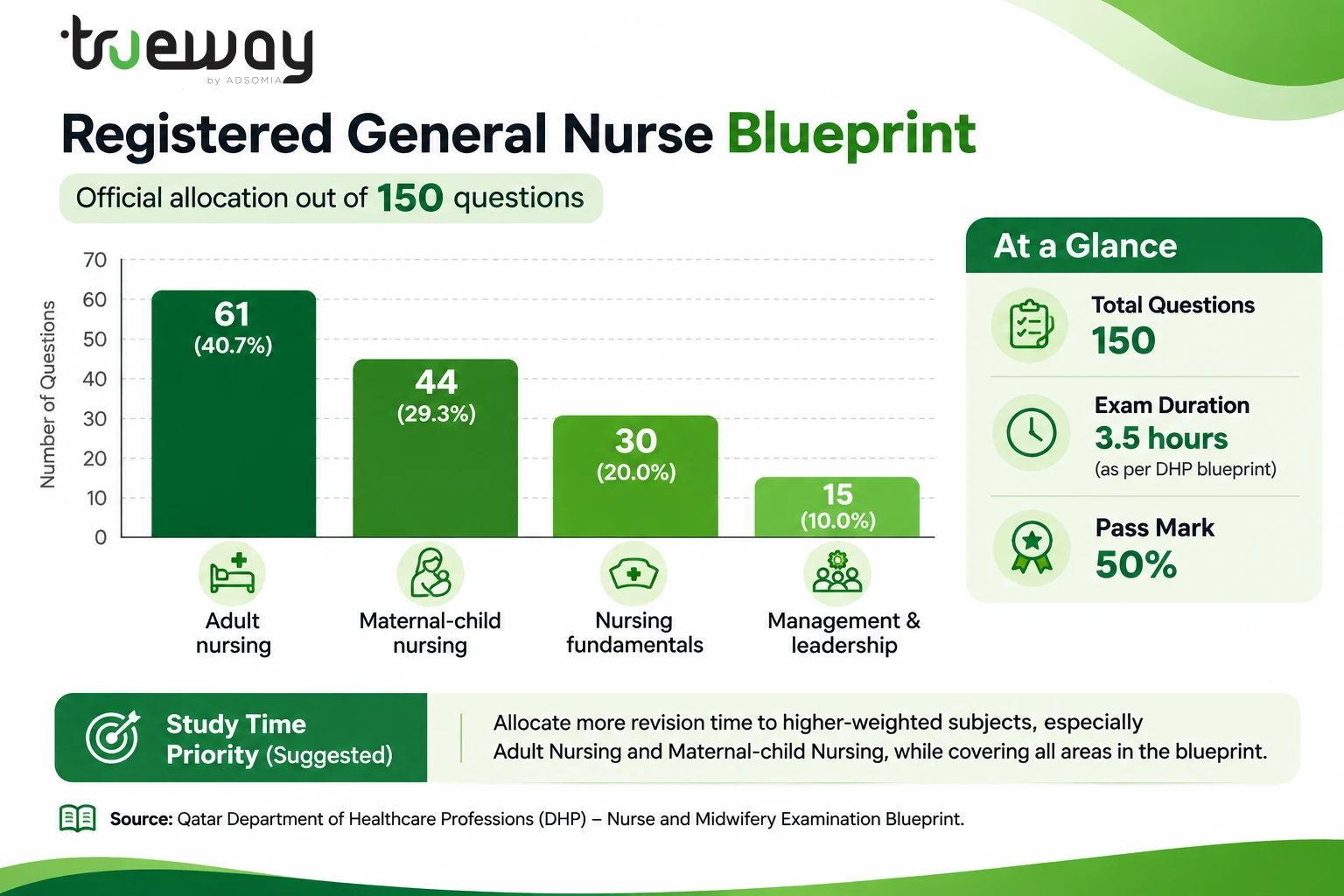
For example, the Registered General Nurse blueprint allocates 61 questions to Adult Nursing, 44 to Maternal-Child Nursing, 30 to Nursing Fundamentals, and 15 to Unit Management and Leadership. Adult Nursing accounts for the largest share of the 150-question examination, making it a priority for revision. However, candidates should still cover all four areas.
Source: Official DHP Nursing and Midwifery Examination Blueprint.
Other healthcare professionals should follow their own subject requirements.
| Healthcare profession | Main preparation areas | Detailed Trueway guide |
|---|---|---|
| Nurses | Adult Nursing, Maternal-Child Nursing, Nursing Fundamentals, Management and Leadership | Qatar Prometric for Nurses |
| Doctors | Medicine, Paediatrics, Obstetrics and Gynaecology, Surgery for General Practitioners | Qatar Prometric for Doctors |
| Pharmacists | Clinical Sciences, Pharmaceutical Sciences, Biomedical Sciences and related professional subjects | Qatar Prometric for Pharmacists |
| Dentists | Clinical Skills, Scientific Knowledge and Affective Skills | Qatar Prometric for Dentists |
| Lab Technicians | Microbiology, Clinical Chemistry, Haematology, Blood Banking and related laboratory subjects | Qatar Prometric for Lab Technicians |
| Physiotherapists | Anatomy, Kinesiology, Clinical Decision Making, Therapeutic Exercises and other physiotherapy subjects | Qatar Prometric for Physiotherapists |
These are brief subject summaries, not complete examination syllabi. Use the linked guides for profession-specific information and the official DHP blueprint to decide how much time to allocate to each subject.
How to Practise MCQs and Mock Tests Effectively
MCQ practice helps you check whether you can apply what you have studied. Reading a chapter and recognising its main points is different from answering a question without looking at the book.
Regular self-testing can reveal knowledge gaps that are easy to miss during revision. It also helps you become familiar with the process of reading questions, comparing options and choosing the most appropriate answer.
How to approach clinical MCQs
When answering a multiple-choice question, use a consistent method.
- Read the question carefully. Identify exactly what is being asked.
- Look for important details. In clinical questions, these may include patient symptoms, observations, test results or other relevant information.
- Compare the answer options. Consider which option is best supported by the details provided.
- Choose the most appropriate answer. Avoid selecting an option merely because it contains a familiar term.
- Review the explanation. Understand why the correct answer is appropriate and why the other options are less suitable.
In clinical questions, pay particular attention to professional judgement, patient safety and relevant clinical guidance. Understanding the reasoning behind an answer is more useful than simply memorising the correct option.
Why should you review incorrect MCQ answers?
An incorrect answer tells you where you need more work. For example, you may repeatedly make mistakes because you do not understand a subject, misread the question, forget a calculation, or struggle to compare similar options.
Keep an MCQ error log to identify these patterns and decide what to revise next.
| Topic | Mistake identified | What to do next |
|---|---|---|
| Infection prevention | Knowledge gap | Review the relevant reference chapter |
| Medication calculations | Calculation error | Practise additional calculation problems |
| Clinical scenarios | Important detail missed | Practise identifying key information |
| Patient safety | Difficulty comparing options | Review applicable clinical principles |
Illustrative learning example, not a record of actual Qatar Prometric questions.
Review the error log every few days. If the same problem keeps appearing, spend more time understanding the concept before moving to another large question set.
How to Take Timed Qatar Prometric Mock Tests
Timed mock tests help you assess your subject knowledge, answering speed and ability to stay focused. Use the question count and time limit applicable to your examination category, practise on a computer when possible, and avoid checking notes during the test.
For example, 150 questions in three hours allow an average of 72 seconds per question, while 3½ hours allow 84 seconds per question. These are calculated averages for practice, not official time limits for individual questions.
After each mock test, review your incorrect answers and identify subjects that need more attention. Rather than completing several full-length tests without reviewing them, use the results to guide your next revision session. There is no fixed number of mock tests that guarantees a passing result.
Common Mistakes During Qatar Prometric Exam Preparation
Some preparation habits can make studying less effective, even when you spend several hours with your books. The following mistakes are worth avoiding.
| Common mistake | Better approach |
|---|---|
| Using a general Prometric question bank without checking the examination category | Choose materials relevant to the Qatar DHP blueprint for your profession |
| Spending equal time on every subject | Consider official subject weightings along with your personal weak areas |
| Memorising answers without understanding them | Review the explanation and underlying concept |
| Reading notes without testing yourself | Include regular MCQ practice and active recall |
| Avoiding timed mock tests | Practise under realistic examination conditions |
| Repeatedly revising only familiar subjects | Give more attention to areas where mistakes continue |
| Using outdated books or exam-pattern information | Check the current DHP blueprint and official references |
Another mistake is comparing your preparation with candidates from different healthcare professions. A nurse, pharmacist and general practitioner do not have identical examinations, so their study plans should reflect their own professional subjects and required competencies.
How to Know When You Are Ready for the Qatar Prometric Exam
You may be ready to schedule the Qatar Prometric exam when you have covered the required subjects, can complete realistic mock tests within the allotted time, and understand the reasons behind most of your incorrect answers.
Your mock-test performance can help you judge your progress, but no practice-test score can guarantee that you will pass the official examination.
Use this exam-readiness checklist
Before confirming your examination date, ask yourself:
- Have I checked the correct DHP examination blueprint?
- Have I studied every major subject listed in the blueprint?
- Have I revised the subjects where I initially performed poorly?
- Can I complete a full-length practice test within the applicable time?
- Have I reviewed and understood my repeated MCQ mistakes?
- Are my mock-test scores reasonably consistent?
- Have I checked the examination appointment and identification requirements?
If several important areas remain incomplete, consider allowing more time for preparation. Your examination date should reflect your actual readiness rather than the number of days you have already spent studying.
What should you do during the final seven days?
The final week should focus on revision and examination readiness rather than attempting to learn large amounts of unfamiliar material.
You can use the week to:
- Revisit subjects that still cause difficulty.
- Review your MCQ error log.
- Practise timed questions where necessary.
- Revise important formulas, concepts and reference notes.
- Check your Prometric appointment details.
- Plan your travel and allow enough time for rest.
Prometric's official test-centre policies explain examination-day identification and security requirements.
Candidates are generally required to bring valid, original government-issued identification that meets the examination sponsor's requirements. Review the exact instructions in your appointment confirmation, including accepted identification, reporting time, and permitted items.
You should also read Prometric's Before Your Exam guidance before your scheduled test.
Qatar Prometric Coaching and Exam Booking Assistance
You can prepare for the Qatar Prometric exam through self-study if you have suitable reference materials, enough preparation time, and a good understanding of your professional subjects.
However, some candidates prefer structured coaching, especially when they find it difficult to organise subjects, maintain a regular study routine, or assess their progress independently.
How can Trueway International help with Qatar Prometric preparation?
Trueway International offers online Qatar Prometric exam coaching for healthcare professionals preparing for the qualifying examination.
According to Trueway's published programme details, its regular coaching includes:
- A 45-day online programme.
- Recorded video lessons.
- Three to four live tutor sessions each week.
- Topic-wise activities and mock tests.
- More than 1,500 practice questions.
- Study materials available through the Trueway app.
The programme is intended to provide structured preparation for the candidate's relevant examination category. Coaching does not guarantee a passing result, and the final examination outcome is determined by the authorised examination provider.
Need help planning your preparation?
Tell the Trueway team your profession, the examination you intend to take, and when you hope to appear. The team can explain the available coaching programme, schedule and fees.
Enquire About Qatar Prometric Coaching
If you have completed your preparation and are ready to schedule the examination, Trueway also provides Qatar Prometric exam-booking assistance.
Trueway is an independent coaching and documentation support provider. It is not affiliated with Qatar's DHP or Prometric and does not issue professional licences or determine examination results.
Frequently Asked Questions About Qatar Prometric Preparation
Is the Qatar Prometric exam difficult?
The difficulty depends on your examination category, professional knowledge and level of preparation. Candidates may find clinical reasoning or time management challenging even when they understand the underlying subjects. Studying the correct blueprint, practising MCQs and reviewing mistakes can help you prepare more effectively.
Can I prepare for the Qatar Prometric exam in 30 days?
Thirty days may be enough for focused revision if you already understand the main subjects and can study regularly. Candidates who need to rebuild their foundation knowledge may require longer. Start with a diagnostic assessment before deciding how much preparation time you need.
How many times can I take the Qatar Prometric exam?
The official DHP Qualifying Examination page states that applicants can sit for the listed qualifying examinations for five consecutive attempts, regardless of the gap between attempts. Check the current DHP policy and any category-specific requirements before arranging another examination.
Source: DHP Qualifying Examination.
Can I pass the Qatar Prometric exam through self-study?
Self-study is an option for candidates who can follow the official blueprint, use suitable references, and assess their progress through MCQs and mock tests. Coaching may help candidates who want a fixed schedule, tutor guidance or structured practice. Neither method guarantees a passing result.
How can I find out whether I passed the Qatar Prometric exam?
Follow the result-reporting instructions provided for your examination by Prometric and DHP. Result access and reporting procedures should be checked through your examination provider rather than assuming that every candidate receives a result immediately after the test.
You can also refer to Trueway's Qatar Prometric Complete Guide for general examination information.
Final Thoughts
Preparing for the Qatar Prometric exam becomes easier to manage when you know what to study and how to measure your progress.
Start with the official DHP blueprint for your profession. Give enough attention to important subjects, follow a study plan that fits your schedule, and practise MCQs regularly. Use timed mock tests and your incorrect answers to decide where further revision is needed.
A 30-day timetable can help organise your studies, but your readiness matters more than completing a fixed number of study days.
If you need structured guidance, Trueway International can help you understand the available Qatar Prometric coaching options and plan your next step.
Author: Reshma Abdul
Regulatory sources checked: November 19, 2026
Exam patterns, reference lists, policies and exemptions may change. Always check the latest Department of Healthcare Professions information and your Prometric appointment instructions before making examination decisions.
About this guide
Written by Reshma Abdul. Updated . Rules change: we check the current rule for your case before you start.