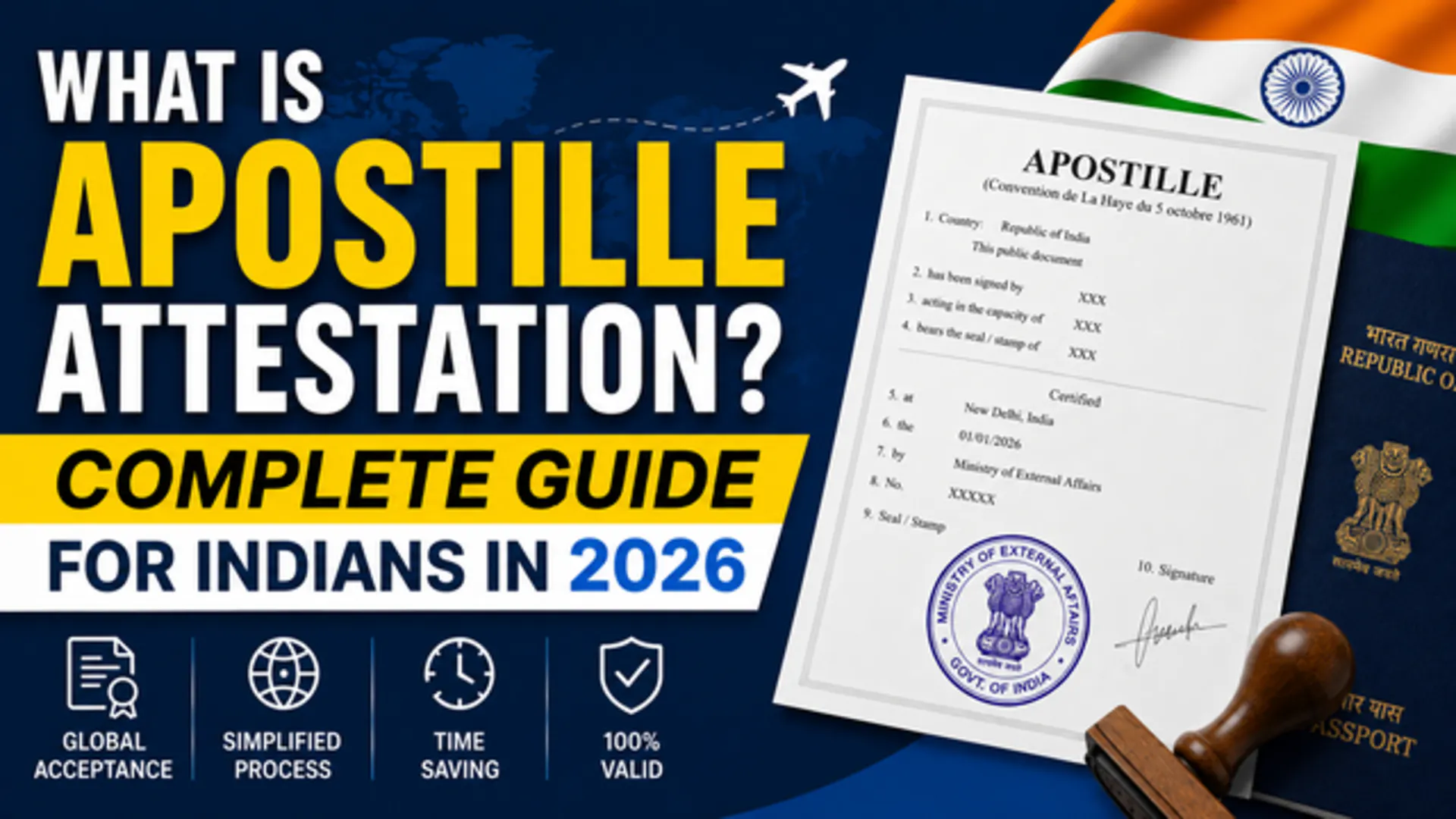
Apostille Attestation is the official certification issued by India's Ministry of External Affairs (MEA) that makes your Indian documents legally valid in 120+ countries under the Hague Convention. It replaces the need for separate embassy legalization in those countries. The MEA charges ₹50 per document, and the full process — including state verification — typically takes 7–15 working days.


1. What is Apostille Attestation?
Apostille attestation is a standardized international certification that authenticates the origin and genuineness of a public document issued in one country for legal use in another country. It is governed by the Hague Convention of 1961—formally titled the "Convention Abolishing the Requirement of Legalization for Foreign Public Documents."
In India, the authority to issue an apostille rests solely with the Ministry of External Affairs (MEA) of the Government of India.
Physically, an apostille is a computer-generated sticker affixed to the back of your original document. It carries a unique identification number and an MEA seal and is verifiable online through the MEA's e-Register.
What the apostille confirms, specifically:
- That the signature on the document is genuine
- The identity and capacity of the person who signed or sealed the document
- The authenticity of the stamp or seal that the document carries
What the Apostille does NOT confirm:
- The content or accuracy of the document itself
- Whether the information stated in the document is factually correct
This is an important distinction. An apostille is a certification of origin and authentication, not a guarantee of the contents' truth.
2. Why Do Indians Need an Apostille in 2026?
India sends millions of people abroad every year — nurses to the UK and Australia, engineers to Canada, students to Germany, and workers to the Gulf. Every one of them needs their Indian documents to be recognized by foreign governments, universities, hospitals, and employers.
Without an apostille or attestation, a degree certificate issued by Calicut University, a birth certificate from Kerala's municipality, or a marriage certificate from a sub-registrar office has no legal standing abroad. The foreign authority has no way to verify it is genuine.
An apostille solves this problem—it is the internationally recognized stamp that tells a foreign institution: "This document was issued by a legitimate Indian authority and has been certified by India's Ministry of External Affairs."
Here is who needs an apostille in 2026:
- Nurses, doctors, and healthcare professionals going to Australia (AHPRA), the UK (NMC), Ireland (NMBI), or other Hague countries
- Students applying to universities in Germany, France, the Netherlands, Ireland, or any Hague Convention country
- Skilled workers and IT professionals applying for jobs or work visas in Europe, Australia, and Canada
- NRIs and families applying for dependent visas, spouse visas, or family reunification
- Businesses needing commercial documents authenticated for international trade, company registration, or tenders abroad
No delay;
Put your details here
3. Apostille vs. Regular Attestation—What Is the Difference?
This is the most searched question in this space—and it confuses thousands of applicants every year. Here is the clearest possible answer.
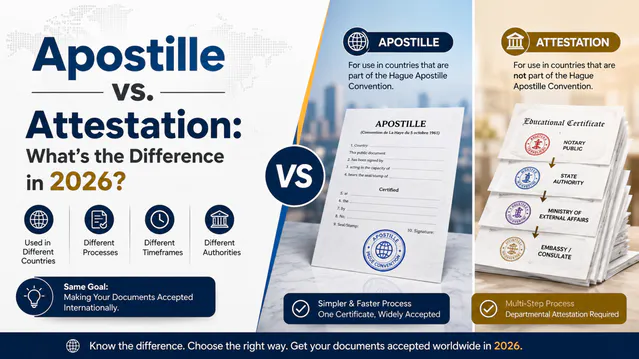
Feature | Apostille | Embassy Attestation |
Governed by | Hague Convention (1961) | Bilateral agreements |
Applicable for | 120+ Hague member countries | Non-Hague countries |
Process steps | State verification → MEA Apostille | State → MEA → Embassy → MOFA |
Time taken | 7–15 working days | 15–30+ working days |
Result | Single Apostille sticker | Multiple stamps |
Examples of destination | UK, Australia, Germany, Canada, France | UAE, Saudi Arabia, Qatar, Kuwait |
The simplest rule: If your destination country is a signatory to the Hague Apostille Convention, you need an apostille. If it is not—like the UAE, Saudi Arabia, Qatar, Kuwait, Bahrain, and Oman—you need embassy attestation followed by that country's Ministry of Foreign Affairs (MOFA) stamp.
Important 2026 note: UAE, Qatar, and most Gulf Cooperation Council (GCC) countries are NOT part of the Hague Convention. If you are going to work in Dubai or Riyadh, you need embassy attestation—not an apostille. Many applicants make this mistake and waste weeks. Always check your destination country first.
4. Which countries accept an apostille from India?
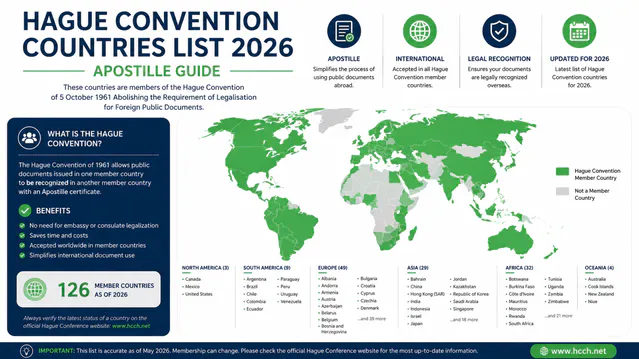
India's apostille is accepted in all countries that have signed the Hague Apostille Convention. As of 2026, this includes 120+ countries. Key destinations for Indians:
Europe: UK, Germany, France, Netherlands, Ireland, Spain, Belgium, Norway, Latvia, Poland, Malta, Croatia, Ukraine, Armenia, Georgia
Australia & Oceania: Australia, New Zealand, Marshall Islands,
Americas: USA, Canada, Panama
Asia: South Korea, Hong Kong, Singapore, Malaysia, Philippines, Thailand, Indonesia, Taiwan, Kazakhstan
Africa: South Africa, Mauritius, Kenya, Ethiopia
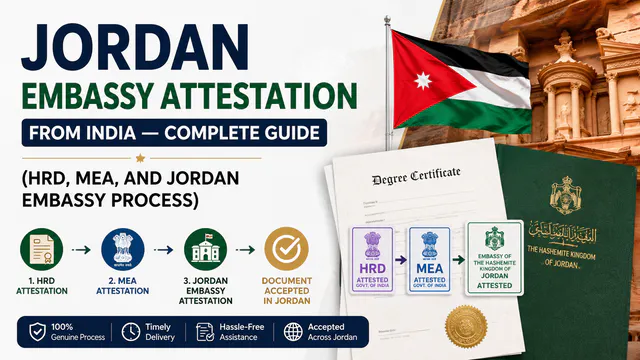
Countries that do NOT accept Apostille (need Embassy Attestation instead): UAE, Saudi Arabia, Qatar, Kuwait, Bahrain, Oman, Iraq, Yemen, Jordan, Libya
5. Which Documents Can Be Apostilled in India?
The MEA issues an Apostille for three categories of documents:
Personal Documents
- Birth certificate
- Death certificate
- Marriage certificate
- Divorce decree
- Affidavit
- Power of Attorney
- Single status / unmarried certificate
- Adoption papers
Educational Documents
- Degree certificate (B.Sc, MBBS, BDS, B.Pharm, BSc Nursing, etc.)
- Diploma certificate
- SSLC / Class 10 mark sheet
- HSC / Class 12 mark sheet
- Transfer certificate
- Migration certificate
- Marksheets from all boards and universities
Commercial Documents
- Memorandum of Association
- Articles of Association
- Board resolutions
- Certificate of incorporation
- Export documents
- Financial statements
Documents that CANNOT be apostilled:
- Laminated documents
- Documents with unreadable signatures or seals
- Commercial contracts and invoices
- Customs and diplomatic papers
- ID cards like Aadhaar or PAN (these are not public documents for international use)
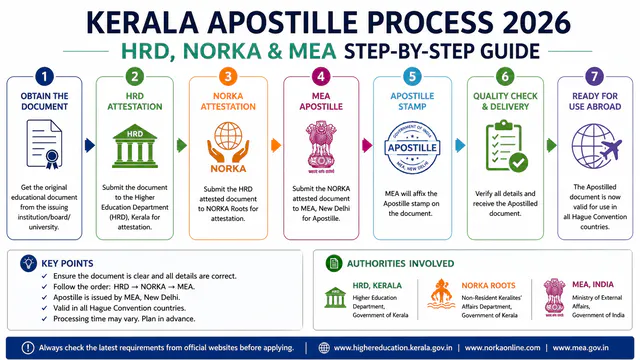
6. Step-by-Step Apostille Process in India (2026)
The apostille process in India follows a fixed hierarchy. You cannot skip any step. Here is how it works:
Step 1: State-Level Authentication
Before MEA will accept your document, it must be authenticated by the appropriate state government authority.
- For personal documents (birth, marriage, and death certificates): Authenticated by the Home Department or General Administration Department (GAD) of the state from where the document was issued.
- For educational documents (degree, diploma, marksheets): Authenticated by the State HRD (Human Resources Development) Department.
- For commercial documents: Pre-authenticated by the respective chamber of commerce.
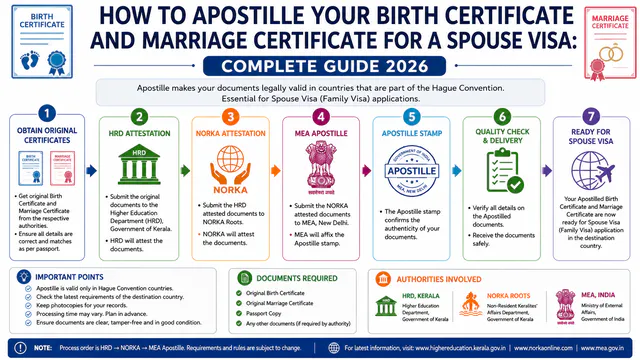
Kerala-specific: In Kerala, educational documents go through the Kerala HRD (or the university's own verification channel). Personal documents go through the Home Department. Kerala also has the NORKA ROOTS channel for Keralites — more on this below.
Time taken at the state level: 3–7 working days (varies by state and document type)
Step 2: Submit Documents Through an MEA-Authorised Channel
In India, apostille services are processed only through authorised channels approved by the Ministry of External Affairs (MEA). Individuals cannot usually submit documents directly to the MEA for apostille processing.
After completing the required state-level verification, your documents must be submitted through an authorised submission centre or a trusted document attestation service provider. These agencies coordinate with the MEA or the Regional Passport Office (RPO) to complete the apostille procedure and return the documents after the apostille sticker is issued.
To make the process easier, many applicants prefer using professional apostille assistance services such as Trueway International, which can manage the complete process on your behalf — including document collection, state authentication, MEA apostille submission, tracking, and secure doorstep delivery.
Step 3: MEA Apostille Stamping
MEA (or the regional passport office handling your jurisdiction) verifies the state-level authentication and affixes the apostille sticker on the back of your original document.
The sticker contains:
- A unique identification number
- MEA's official seal
- Date of issue
- A QR code (for digital verification)
MEA Government fee: ₹50 per document
Step 4: Collect Your Apostilled Document
Once MEA processing is complete, the outsourced agency returns the document to you, either through doorstep delivery or office pickup.
Step 5 (For Non-Hague Countries Only): Embassy Attestation + MOFA
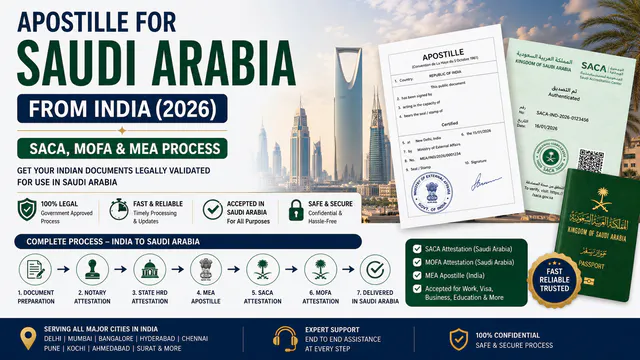
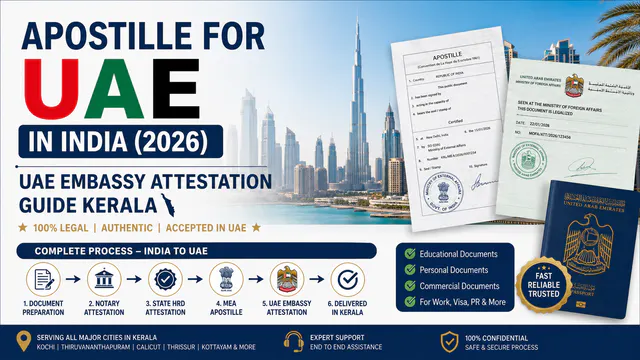
If your destination is the UAE, Saudi Arabia, Qatar, Kuwait, Bahrain, or Oman, your document needs an additional step after MEA:
- Embassy Attestation — the respective country's embassy in India stamps your document
- MOFA Attestation—after arriving in the destination country, MOFA stamps confirm the embassy's authentication
For GCC countries, this is not optional — it is mandatory.
7. What Has Changed in 2026: e-Sanad and Digital Apostille
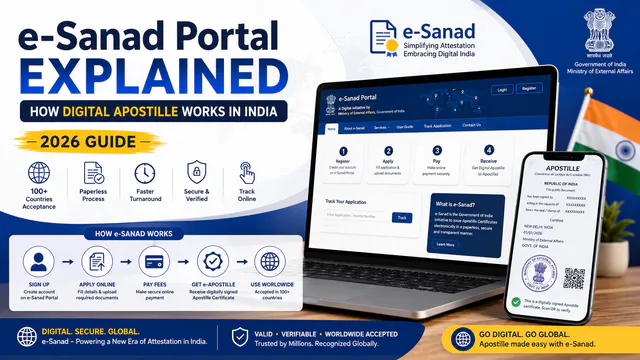
2026 is a significant year for apostilles in India. The MEA has substantially expanded the e-Sanad portal—India's digital platform for document attestation and apostille.
What e-Sanad does: e-Sanad is a contactless, faceless, cashless, and paperless system for document verification and apostille. It connects MEA directly with Document Issuing Authorities (DIAs) that maintain digital depositories of their documents.
What has changed in 2025–2026:
- A digital apostille is now the standard for eligible documents—no need to courier physical documents internationally
- Processing time has reduced from 30–45 days to approximately 15–20 working days for e-Sanad-eligible documents
- Digital apostille certificates include a QR code and a unique number that foreign institutions can verify instantly online via MEA's e-Register
- CBSE documents from 2014 onwards are fully integrated into e-Sanad
- National Academic Depository (NAD) documents are also included
What e-Sanad does NOT yet cover: Not all documents are e-Sanad eligible. Documents that are not in a digital depository must still follow the physical process through MEA's outsourced agencies. State board documents, older university certificates, and many personal documents still require physical submission.
Pro tip for 2026: Before starting your apostille process, check whether your document's issuing authority (your university, state board, or registrar) is integrated with the e-Sanad portal. If it is, you can complete the entire process without physically going anywhere.
How to access e-Sanad: Visit esanad.nic.in—the official Government of India portal.
8. Apostille Fees and Timeline
Professional Apostille Service Charges
Professional apostille service providers usually offer end-to-end assistance for the complete process, including:
- Document collection from your location
- State HRD / Home Department verification
- MEA apostille submission and coordination
- Secure doorstep delivery
- Regular application status updates
Choosing a trusted agency like Trueway International helps simplify the entire procedure and saves considerable time and effort, especially for applicants handling multiple documents or residing outside major cities. The service is designed to be affordable, convenient, and hassle-free for students, job seekers, and families requiring international document authentication.
Processing Timelines
Stage | Time (Estimated) |
State HRD / Home Department verification | 3–7 working days |
MEA Apostille (physical submission) | 5–7 working days |
MEA Apostille (e-Sanad / digital eligible) | 15–20 working days total |
Embassy Attestation (after MEA, for non-Hague) | 5–10 additional working days |
Full UAE attestation (HRD → MEA → Embassy → MOFA) | 16–25 working days |
Fast-track services (through authorised agencies) | 2–5 working days |
Important: Timelines can extend during peak visa seasons (April–June, October–December). Always plan for at least 2–3 weeks of buffer time if you have an urgent visa deadline.
9. Kerala-Specific: NORKA ROOTS and the Trivandrum RPO
For Keralites, there is an important local detail that most national guides miss.
NORKA ROOTS (Non-Resident Keralites Affairs)—a public sector company under the Government of Kerala—is officially authorized by MEA to submit documents for attestation and apostille at the Regional Passport Office (RPO), Trivandrum.
This is significant for Keralites because
- You do not need to send documents to New Delhi—the Trivandrum RPO processes MEA Apostille locally
- NORKA ROOTS offers a structured submission channel specifically designed for Kerala's large non-resident population
- This reduces transit time and the risk of document loss
The Trivandrum RPO was among the first five decentralized RPO locations for MEA Apostille services (alongside Bangalore, Chandigarh, Goa, and Mumbai), operationalized on 13 October 2016.
What this means for Kerala healthcare professionals
If you are a nurse, doctor, pharmacist, or paramedical worker from Kerala preparing documents for the UK (NMC), Australia (AHPRA), Ireland (NMBI), or the Gulf, you have two options:
- Use NORKA ROOTS to submit documents to Trivandrum RPO (for MEA Apostille)
- Use a professional agency like Trueway International that handles the NORKA channel and the full attestation chain on your behalf, from Kerala HRD to MEA to the embassy if required
Trueway International operates branches in Trivandrum (TVM), Attingal, Kochi, Chennai, and Bangalore—giving Kerala professionals local access to end-to-end attestation support.
10. Common Mistakes That Cause Apostille Rejection
Approximately 30–40% of apostille applications face delays or rejection. Here are the most common reasons—and how to avoid them:
Mistake 1: Skipping state verification. Many applicants try to submit documents directly to MEA without state HRD or home department authentication first. MEA will reject these outright. → Always complete state-level authentication before MEA submission.
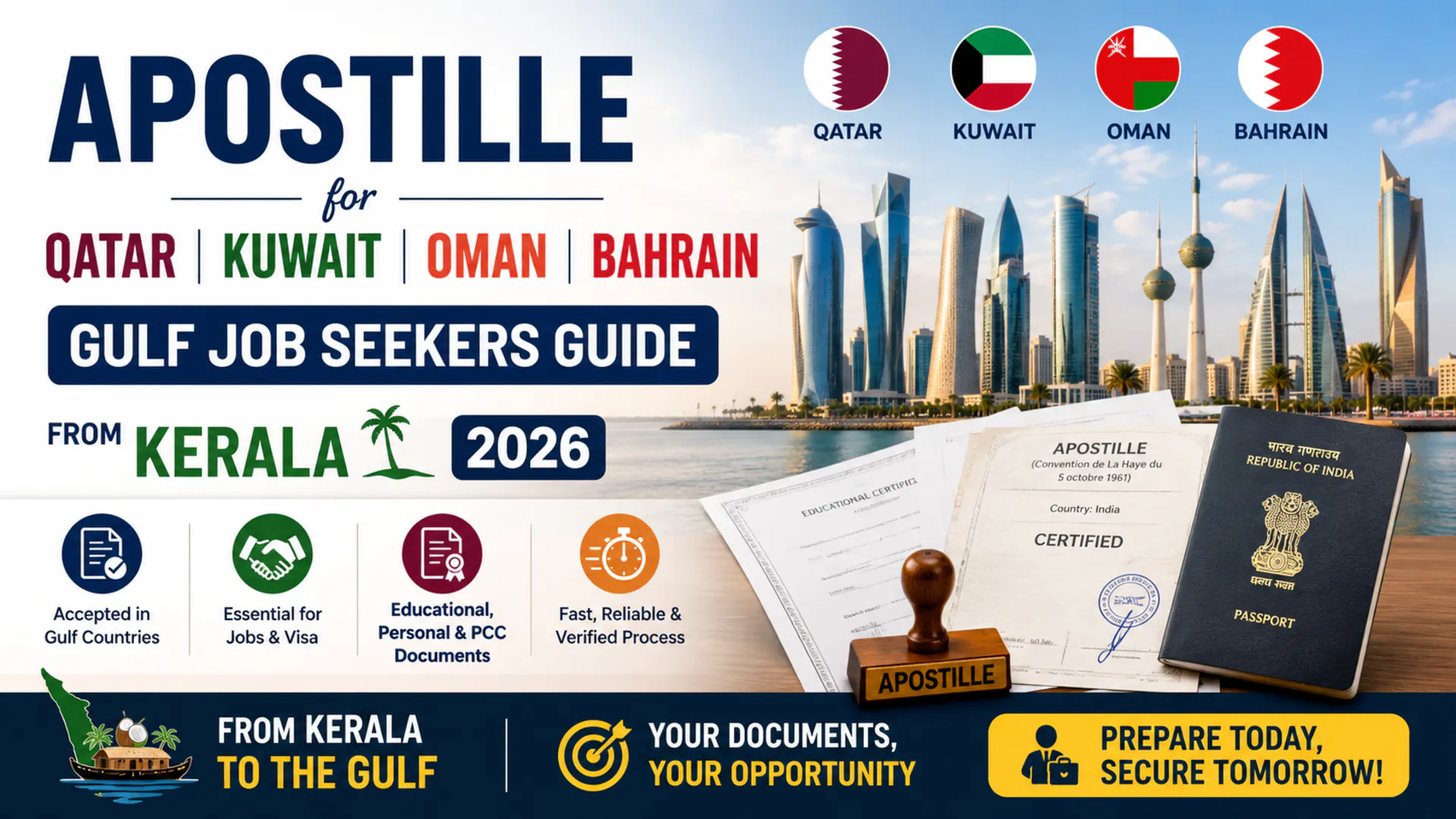
Mistake 2: Apostilles for Gulf countries UAE, Saudi Arabia, Qatar, Kuwait, Bahrain, and Oman are not Hague Convention members. An apostille is useless for these destinations. You need Embassy Attestation + MOFA. → Always verify your destination country's convention status first.
Mistake 3: Submitting laminated documents. Laminated certificates cannot have the apostille sticker affixed on the reverse. MEA will reject them. → If your certificate is laminated, get an attested true copy first.
Mistake 4: Name mismatches across documents. If the name spelling on your degree certificate differs from your passport (e.g., "Muhammed" vs. "Muhammad"), this can cause rejection. → Verify all name spellings match exactly across all documents before submission.
Mistake 5: Incomplete document sets. MEA requires the original document, one photocopy of the document, and one photocopy of the applicant's passport. → Always submit a complete set — missing any one component causes a delay.
Mistake 6: Urgency without fast-track enrollment. Many applicants need documents urgently but do not enroll for fast-track service, resulting in missed visa deadlines. → If you have a deadline, tell your agency upfront. Fast-track services are available.
11. Apostille for Different Personas — What You Specifically Need
For Kerala Nurses and Healthcare Professionals Going to the UK or Australia:
Documents typically needed:
- BSc Nursing / GNM Diploma certificate (Apostille)
- Marksheets (Apostille)
- Experience certificate from previous hospital (Apostille)
- Good Standing Certificate from Kerala Nurses and Midwives Council (KNC)—this is separate from Apostille
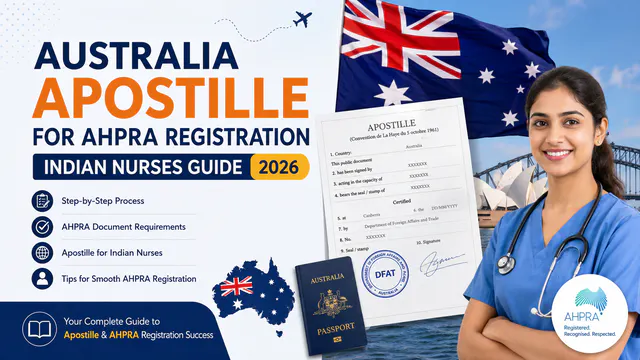
Your process: Kerala HRD → MEA Apostille (Trivandrum RPO) → Submit to NMC (UK) or AHPRA (Australia)
Note: For the UK and Australia, an apostille is sufficient. These are Hague countries.
For Students Going to Germany, France, or the Netherlands
Documents typically needed:
- Degree / final year marksheet (Apostille)
- Transcripts from university (Apostille)
- Birth certificate (Apostille for family visa if applicable)
Your process: University verification → State HRD → MEA Apostille → German embassy (if visa required, not the same as MOFA)
Note: Apostille is sufficient. Germany, France, and the Netherlands are Hague-Convention countries.
For Skilled Workers Going to the Gulf (UAE, Saudi Arabia, Qatar)
Documents typically needed:
- Degree certificate (Embassy Attestation—NOT Apostille)
- Experience certificates (Embassy Attestation)
- Medical fitness certificate (Separate process)
Your process: State HRD → MEA → Embassy Attestation → Destination country MOFA
Note: For GCC countries, you need the full attestation chain, not just an apostille.
For NRIs Managing Documents from Abroad:
If you are already abroad and need Indian documents apostilled:
- You can authorise a trusted family member or a professional agency (like Trueway International) to collect and process documents on your behalf
- e-Sanad-eligible documents can sometimes be processed without physical presence in India
- Your authorised agent submits a notarised Power of Attorney along with the documents
Trueway International has handled hundreds of such cases for NRIs in the UAE, UK, and Australia.
For Businesses with Commercial Documents
Commercial documents (Memorandum of Association, board resolutions, and export certificates) must be pre-authenticated by the relevant Chamber of Commerce before MEA Apostille.
The Apostille makes Indian commercial documents legally recognized in Hague Convention countries for company registration, international tenders, and foreign branch operations.
12. Frequently Asked Questions
No, an apostille is a single-step MEA certification for Hague Convention countries. Embassy attestation is a multi-step process required for non-Hague countries like the UAE, Saudi Arabia, and Qatar.
13. How Trueway International Helps You
At Trueway International, we have been handling apostille attestation for Indians for over 15 years. We understand that for most people—a nurse getting ready to leave for the UK, a family preparing a dependent visa application, or a student who just got an admission offer from Germany—the document process is stressful, confusing, and time-sensitive.
Here is what we do differently:
- End-to-end handling—We pick up your documents, handle state HRD/Home Department verification, submit to MEA through the official channel, and deliver to your door. You do not visit a single government office.
- Kerala-rooted expertise — With branches in Trivandrum, Attingal, Kochi, Chennai, and Bangalore, we know the Kerala HRD system, NORKA ROOTS channel, and Trivandrum RPO process inside out.
- Multi-service integration—If your documents also need Dataflow verification (DHA, MOH, HAAD, etc.), good standing from KNC or the Pharmacy Council, or PCC from India or abroad, we handle all of it from one place.
- Transparent timelines — We tell you upfront how long it will take and keep you updated through every stage.
- NRI-friendly — Living abroad? We work with a power of attorney arrangement and handle everything while you stay where you are.
Summary: Key Facts About Apostille Attestation in India (2026)
Question | Answer |
What is an apostille? | MEA certification for international document authentication |
Who issues it in India? | Ministry of External Affairs (MEA), Government of India |
Legal basis | Hague Convention, 1961 |
Countries accepted | 120+ Hague Convention members |
Typical timeline | 7–15 working days (full process) |
e-Sanad digital processing | 15–20 working days for eligible documents |
Kerala submission point | Trivandrum RPO (via NORKA ROOTS or agencies) |
Documents needed | Original document + photocopy + passport copy |
Not valid for | UAE, Saudi Arabia, Qatar, Kuwait (need Embassy Attestation) |
This guide is published by Trueway International, a leading attestation consultancy with branches across South India. While we strive to ensure all information is accurate and current, apostille requirements can change. Always verify country-specific requirements with your receiving institution or contact our specialists directly.
Related reads from Trueway International
- Apostille vs. Embassy Attestation—Which do you need and when?
- Step-by-step Apostille process in Kerala—from HRD to MEA
- Hague Convention Countries List 2026 — Does Your Destination Country Need an Apostille?
- e-Sanad Portal Explained — How Digital Apostille Works in India in 2026
- How to Apostille Your Birth Certificate and Marriage Certificate for a Spouse Visa — Complete Guide 2026
- Apostille for UAE — Complete Guide for Indian Professionals and Families in 2026
- Apostille for Saudi Arabia — Documents, Process, and MOFA Attestation for Indians in 2026
- Apostille for Australia — What Indian Nurses Need to Know for AHPRA Registration
- Apostille for Qatar, Kuwait, Oman, and Bahrain — Gulf Job Seekers Guide from Kerala 2026