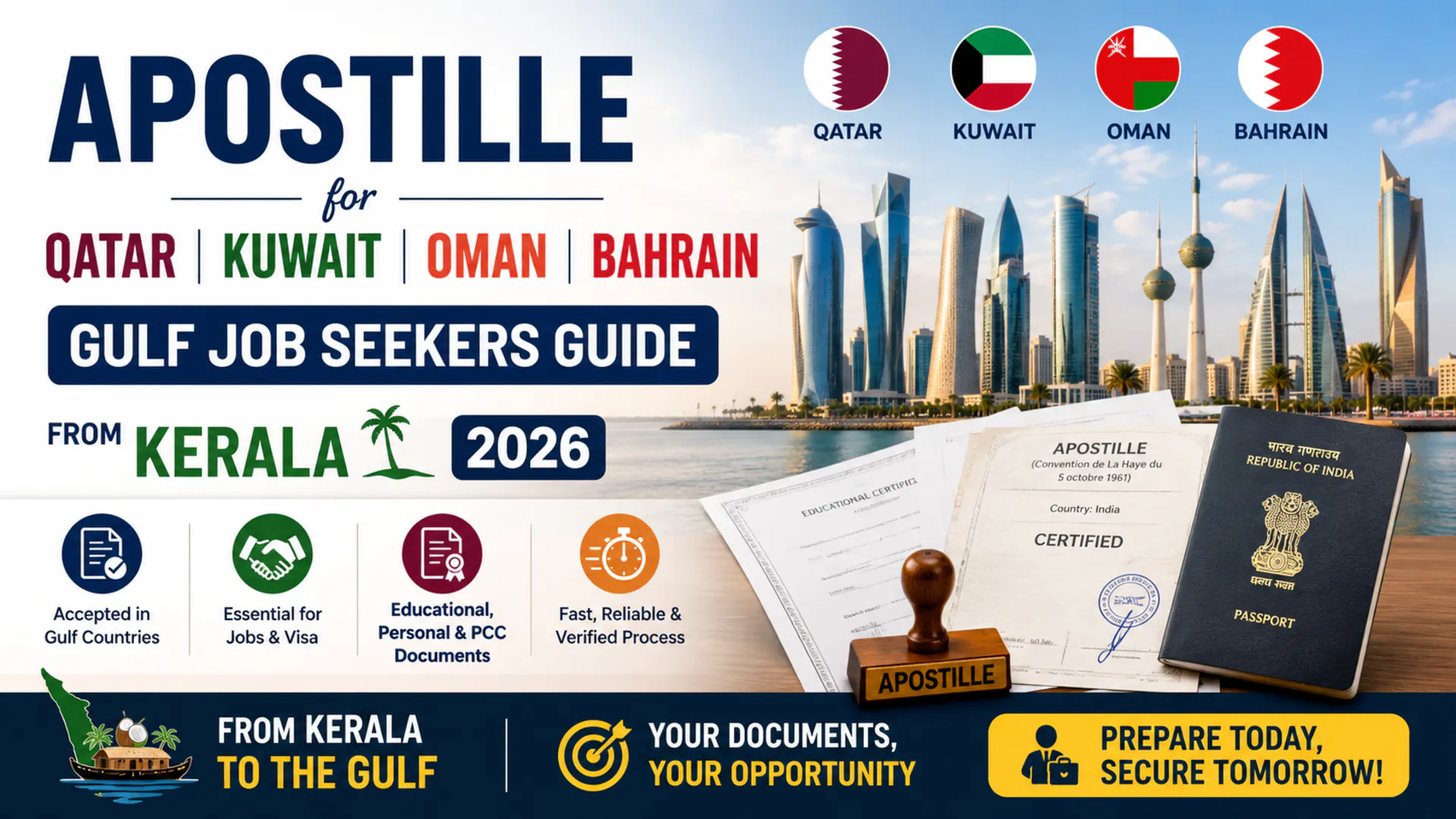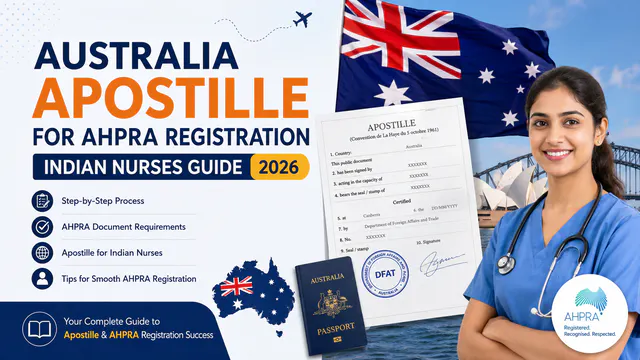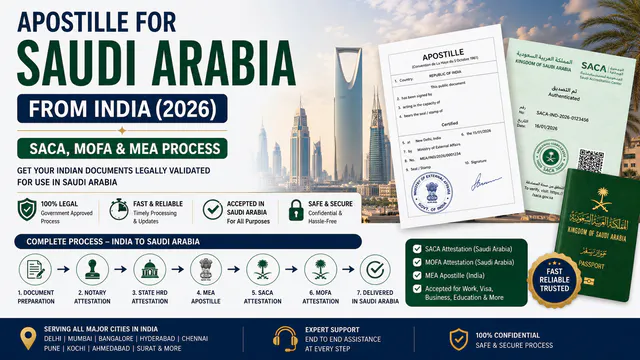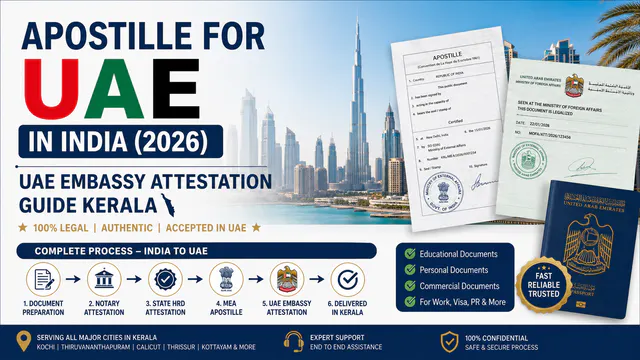
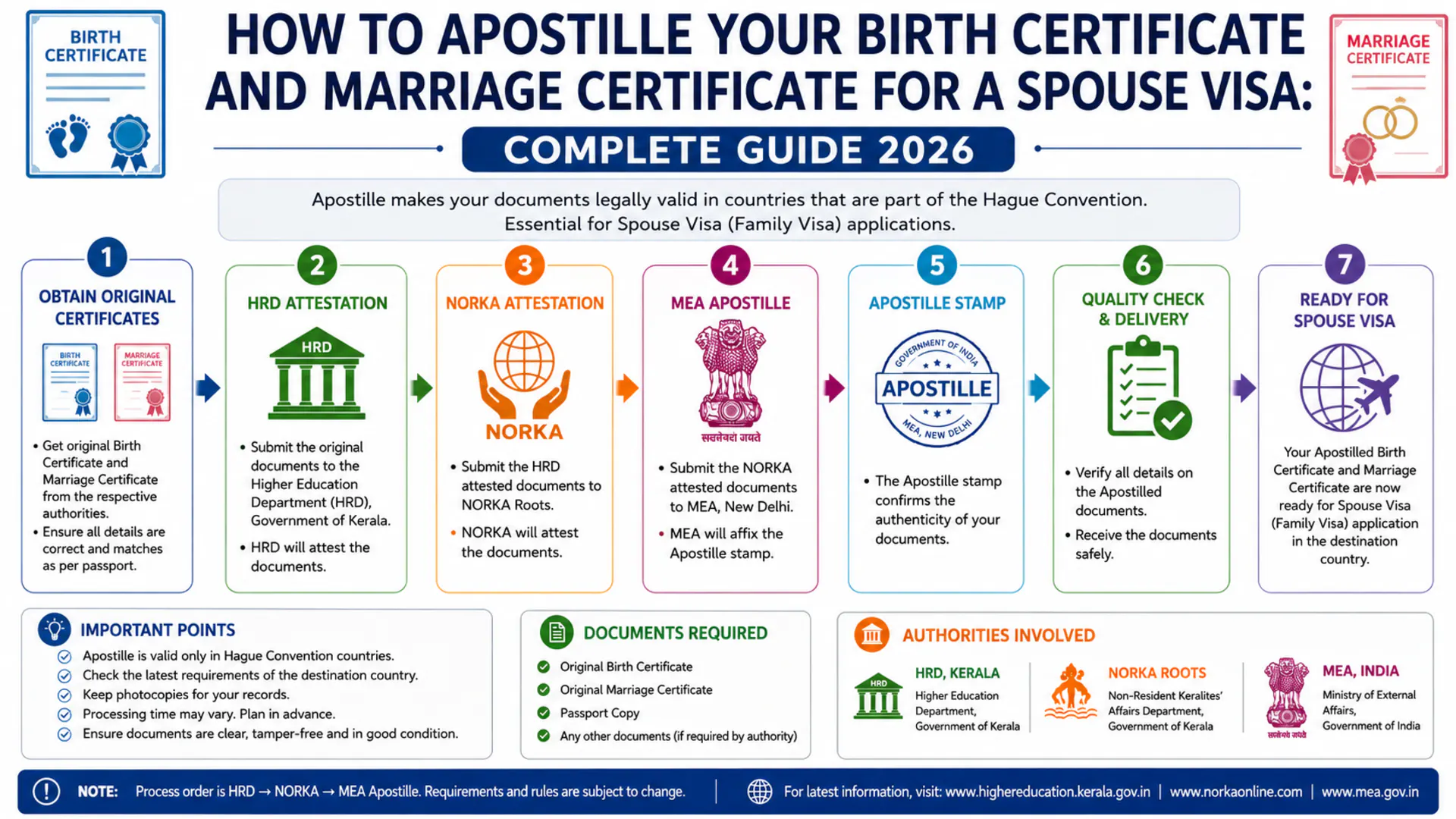
To apostille a birth certificate or marriage certificate for a spouse visa, your document goes through state-level authentication—the Kerala Home Department or SDM—followed by MEA apostille via the Trivandrum Regional Passport Office. This applies to Hague Convention countries, including the UK, Australia, Canada, and Ireland. For the UAE, Qatar, and Kuwait, embassy attestation is required instead. The government process involves multiple authorities and takes several weeks on its own—working with a professional agency compresses this significantly and eliminates the risk of rejection.


The Document Step That Holds Up More Spouse Visa Applications Than Anything Else
You did the hard part. The job abroad is confirmed. The visa for the sponsoring spouse is sorted. Now you are putting together the family visa or dependent visa application — and the checklist says: "Apostilled marriage certificate. Apostilled birth certificate."
You search online. You find guides that say, "go to the government office and get it apostilled." What they do not tell you is which office to go to first, what happens if your marriage was never civilly registered, what to do when your name is spelled differently across three documents, or—most importantly—whether your destination country even accepts apostilles at all.
Missing any one of these details means rejection, restart, and weeks of additional waiting.
For most couples, the documents themselves are not the problem. The process is. And when a joining date or a visa interview is three weeks away, navigating multiple government authorities on your own — each with their own timelines, queues, and requirements — is a gamble most people cannot afford to take.
This guide tells you exactly what the process is, what the common mistakes are, and why most people who go through this successfully did not do it alone.
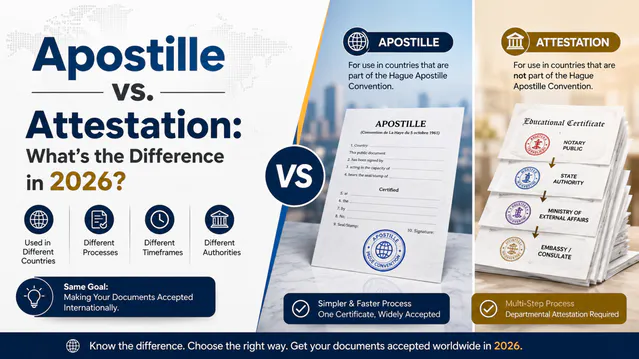
1. The Decision You Must Make Before Anything Else — Apostille or Attestation?
The single question that determines your entire document process:
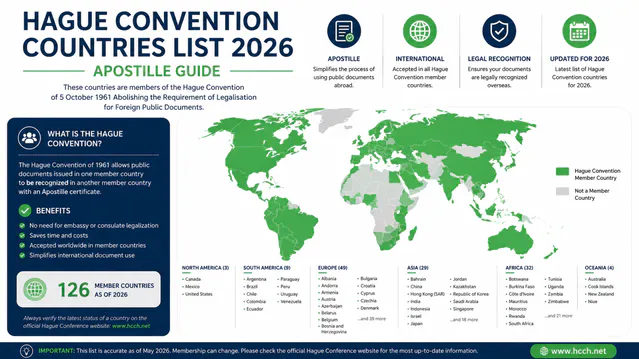
Is your destination country a member of the Hague Apostille Convention?
If yes, you need an MEA apostille.
The UK, Australia, Ireland, Canada, the USA, Saudi Arabia, Bahrain, Oman, Singapore, South Korea, France, and the Netherlands—these are Hague members. For spouse and family visa applications to these countries, an MEA Apostille on your birth and marriage certificates is what immigration authorities accept and recognize.
If no, you need embassy attestation, not an apostille.
UAE, Qatar, and Kuwait are not Hague members. If your spouse or partner is working in Dubai, Doha, or Kuwait City and you are applying for a family residence visa, your marriage and birth certificates need Embassy Attestation — a different, longer, multi-authority process. An MEA Apostille sticker on these documents is worthless in these countries. UAE immigration will not accept it.
The most costly mistake in spouse visa document processing is getting an MEA apostille for documents going to the UAE, Qatar, or Kuwait. These countries are not Hague members. The process must be completely restarted with embassy attestation—adding weeks to a timeline that is almost always already tight.
If you are not certain whether your country accepts an apostille, check the Hague Convention countries list before starting anything. Alternatively, call Trueway International on WhatsApp — we verify this for every client in minutes before any process begins.
Quick destination reference
Destination | Accepts Apostille? | Correct process for spouse visa documents |
United Kingdom | Yes | MEA Apostille |
Australia | Yes | MEA Apostille |
Ireland | Yes | MEA Apostille |
Canada | Yes (since Jan 2024) | MEA Apostille |
USA | Yes | MEA Apostille |
Saudi Arabia | Yes (since Dec 2022) | MEA Apostille |
Bahrain | Yes | MEA Apostille |
Oman | Yes | MEA Apostille |
Singapore | Yes | MEA Apostille |
UAE | No | Embassy Attestation required |
Qatar | No | Embassy Attestation required |
Kuwait | No | Embassy Attestation required |
Germany | Exception — bilateral objection |
Put your details here
2. What Apostille on a Birth or Marriage Certificate Actually Certifies
Understanding what the Apostille stamp does — and what it does not do — helps manage expectations with immigration authorities abroad.
What MEA Apostille certifies:
- That the signature on the document is genuine
- That the authority who signed or sealed the document had the capacity to do so
- That the document came from an authentic Indian government source
What MEA Apostille does NOT certify:
- That the information inside the document is factually true
- Whether the marriage is still valid or ongoing
- That the people named in the document are who they say they are
Immigration authorities use the Apostille to confirm your document is genuine — not fabricated or forged. They then assess the contents of your document alongside the rest of your evidence to make their visa decision.
Quotable fact: According to the Hague Conference on Private International Law (HCCH), "An Apostille is a certificate that authenticates the origin of a public document such as a birth, marriage, or death certificate. It certifies the authenticity of the signature and the capacity in which the person who signed the document acted." It does not verify the contents of the underlying document.
This is why apostilled documents are always submitted alongside supporting evidence—relationship photos, communication records, financial ties, and accommodation details. The apostille makes your document internationally trusted. Your overall application makes your relationship credible.
3. Types of Birth Certificate in India — Which One Can Be Apostilled?
One of the most overlooked questions — and one that causes real-world delays — is which type of birth certificate you actually have.
Type 1 — Registered Birth Certificate (Municipal or Panchayat)
Issued by the municipal corporation (urban areas) or Gram Panchayat (rural areas) from the official Births and Deaths Register. This is a public document issued by a government authority.
Can it be apostilled? Yes. This is the correct document for an apostille.
Type 2 — Hospital-Issued Birth Certificate
Issued by the hospital at the time of delivery. This is a private medical record — not a government-registered civil document.
Can it be apostilled? No. A hospital birth certificate is not a public document under the Hague Convention and cannot be directly apostilled. You must first convert it into a registered birth certificate by applying to your local municipality or panchayat.
Type 3 — Delayed Registration Birth Certificate
Issued when birth was not registered at the time but registered later through the local registrar. This is a valid government document.
Can it be apostilled? Yes, but it may require additional supporting affidavits at the state authentication stage due to the delayed registration.
The rule is simple: If your birth certificate was issued by a government registrar (municipality or panchayat), it can be apostilled. If it was issued by a hospital, it cannot — you need the registered version first. Contact Trueway International before starting if you are unsure which type you have.
4. Registered vs Unregistered Marriage — Why This Changes Everything
This is the most important starting question for a marriage certificate apostille—and the question that most guides skip entirely.
Registered Marriage — Straightforward
If your marriage is registered under any civil law—Hindu Marriage Act 1955, Special Marriage Act 1954, Indian Christian Marriage Act 1872, or any other recognized personal law—you have an official marriage certificate issued by the Registrar of Marriages.
This is a public document and can be directly apostilled through the standard Home Department / SDM → MEA process.
Unregistered Marriage — Different Process
Many Indian marriages — temple ceremonies, church ceremonies, nikah ceremonies — are performed religiously and celebrated with family, but never registered with any civil authority. If your marriage was not registered, you do not have an official government marriage certificate, and therefore, you do not have a document that can be directly apostilled.
Option 1 — Register the marriage retrospectively: Apply at the sub-registrar's office in your district. Both spouses typically need to be present along with witnesses. After registration is complete, you receive an official certificate that can then be apostilled. This is the most comprehensive solution and is accepted by all immigration authorities.
Option 2 — Notarized affidavit of marriage: A notary public prepares an affidavit sworn by both spouses declaring the marriage, which can then be authenticated and apostilled. However — and this is critical — not all immigration authorities accept an affidavit in place of a registered certificate. Before choosing this route, confirm explicitly with your destination immigration authority or your immigration lawyer that an apostilled affidavit is sufficient.
UK Family Visa applicants: The UK Home Office expects strong evidence that the marriage is legally valid under the laws of the country where it took place. For India-performed marriages, a registered certificate is the most straightforward evidence. An affidavit may not be sufficient on its own. Check the official UK Family Visa guidance at gov.uk/family-visa or consult a UK immigration solicitor before deciding.
5. Step-by-Step: How to Apostille a Birth Certificate in India
Applicable for: UK, Australia, Canada, Ireland, USA, Saudi Arabia, Bahrain, Oman, Singapore, and all other Hague Convention member countries.
Step 1 — Confirm You Have the Registered Birth Certificate
Make sure you have the original birth certificate issued by your municipality or panchayat — not the hospital certificate. If you need a replacement or re-issue, apply to your local body. This typically takes a few working days to a couple of weeks, depending on the local body's process.
Step 2 — State Authentication
Before MEA processes the Apostille, your birth certificate must be authenticated by a state-level authority confirming that the signature and seal of the issuing registrar are genuine.
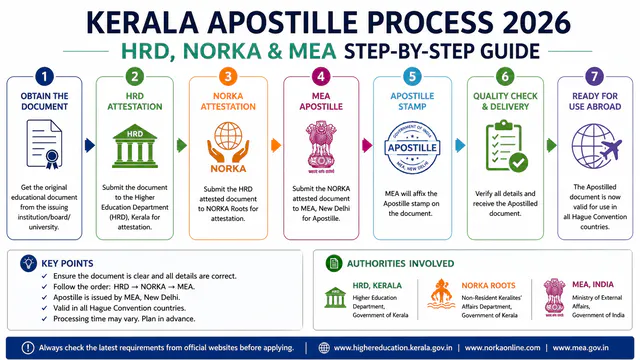
Route A — Kerala Home Department (GAD — General Administration Department): The standard route for personal documents. More widely accepted, particularly by countries that specify state-level authentication.
Route B — SDM (Sub-Divisional Magistrate): A faster alternative accepted for most Hague countries, particularly for employment and immigration purposes. A judicial authority authenticates the document independently of the state government chain.
Which route is right for you? See the step-by-step Kerala apostille guide for the complete decision framework by country and purpose. As a quick reference, Italy and Austria require the Home Department route. UK, Australia, Canada — SDM is generally accepted and significantly faster.
Step 3 — MEA Apostille via Trivandrum RPO
After state authentication, the birth certificate is submitted to MEA through professional channels. For Kerala, MEA processing happens at the Trivandrum Regional Passport Office — not New Delhi — which is one of only five decentralised MEA Apostille centres in India. This keeps your document within South India, reduces transit risk, and leverages local processing relationships that professional agencies maintain.
MEA affixes the Apostille sticker to the reverse of the original document, containing a unique identification number, QR code for verification through MEA's e-Register, MEA seal, and date of issue.
This is the final step for all Hague Convention countries. No embassy visit needed. No further authentication required on arrival. Your apostilled birth certificate is internationally recognised.
Why People Do Not Do This Alone
The government process for apostille involves visiting or couriering to multiple separate authorities — the state Home Department or SDM, then the MEA-authorised channel. Each authority has its own forms, appointment systems, processing queues, and requirements. Getting one detail wrong at any stage — a missing copy, a query on the signature, a name issue — sends the application back to the beginning.
Most people going through a spouse visa application already have a dozen other things to manage. The apostille process is one where handing it to an experienced agency does not just save time — it eliminates the risk of a rejection that restarts the clock on a timeline that cannot afford that.
6. Step-by-Step: How to Apostille a Marriage Certificate in India
Applicable for the UK, Australia, Canada, Ireland, the USA, Saudi Arabia, and all other Hague Convention countries. Not applicable for UAE, Qatar, and Kuwait, which require embassy attestation.
Step 1 — Confirm Your Marriage Certificate Type
Registered or unregistered? See Section 4. If unregistered, decide between retrospective registration and the affidavit route—after confirming which your destination authority accepts.
Step 2 — Check Name Consistency Before Submitting Anything
Before going anywhere near a government office, lay your marriage certificate and both spouses' passports side by side. Compare every element of every name — spelling, order, initials. Any difference between the marriage certificate and the passport is a potential query at the Home Department or MEA stage. In Kerala specifically, this is the single most common cause of delays (explained fully in Section 11). Resolve any mismatch before starting.
Step 3 — Notarization (Affidavit Route Only)
If using a notarized marriage affidavit for an unregistered marriage, this is prepared on stamp paper and sworn before a notary by both spouses. For registered marriage certificates, this step is not required.
Step 4 — State Authentication
Home Department or SDM — same routes as for the birth certificate. Both spouses' passport copies are submitted alongside the certificate.
For personal documents in Kerala, the relevant authority is the Kerala Home Department (GAD) — not NORKA ROOTS. NORKA handles educational document authentication only. This distinction matters: going to NORKA for a birth or marriage certificate wastes time.
Step 5 — MEA Apostille via Trivandrum RPO
Submitted through the authorized channel to Trivandrum RPO. MEA affixes the apostille sticker. The document is then returned, apostilled, and internationally recognized for all Hague Convention countries.
7. Country-Specific Requirements — What Your Destination Actually Asks For
No competitor provides this structured reference. Here is what each major destination immigration system specifically expects for spouse or family visa document submissions from India.
United Kingdom — UK Family Visa (Spouse / Settlement)
Authority: UK Home Office | Official resource: gov.uk/family-visa
Marriage certificate: Apostilled. If not in English, a certified English translation is required alongside. Birth certificate: Increasingly required for applicants and children. Apostilled. Kerala-issued certificates are in English — no translation needed.
What UK immigration is really assessing: Proof that the marriage is genuine and legally valid under Indian law, combined with evidence of a continuing relationship. Apostilled documents satisfy the formal authentication requirement. Your relationship evidence file — photos, communication, travel history, financial ties — satisfies the substance requirement. Both are needed.
Australia — Partner Visa (Subclass 309/100 or 820/801)
Authority: Australian Department of Home Affairs | Official resource: homeaffairs.gov.au
Marriage certificate: Apostilled. Certified English translation if not in English (Kerala certificates are in English). Birth certificate: Apostilled if required for your category.
Note: The Department of Home Affairs may request original documents alongside apostilled copies for some application categories. Confirm with your migration agent whether apostilled originals are sufficient or whether additional original certified copies are needed before submitting your package.
Canada — Spousal Sponsorship (PR through IRCC)
Authority: Immigration, Refugees and Citizenship Canada (IRCC)
Canada joined the Hague Convention on 11 January 2024. MEA Apostille is now the accepted route for Canadian spousal sponsorship — replacing the previous embassy attestation requirement.
Marriage certificate: Apostilled. Translation to English or French is required if the certificate is not in either language. Birth certificate: Apostilled if required for your category.
Ireland — Join Family / Spouse of an Irish Citizen Visa
Authority: Irish Naturalisation and Immigration Service (INIS)
Marriage certificate: Apostilled. Kerala-issued English-language certificates are accepted without translation. Birth certificate: Apostilled if required.
Saudi Arabia — Family Visa for Dependent Spouse
Saudi Arabia joined the Hague Convention on 7 December 2022. MEA Apostille is now the correct route.
Marriage certificate: Apostilled. Arabic translation is often required by Saudi immigration or your sponsor — confirm with your employer. Birth certificate: Apostilled.
UAE — Family / Residence Visa for Dependent Spouse
An apostille is not accepted. The UAE is not a Hague-Convention member.
Correct process: Kerala Home Department → MEA Attestation → UAE Embassy in India → UAE MOFA.
This is a significantly more involved process with more authorities, longer timelines, and higher complexity than Apostille. Trueway International handles the complete UAE family visa attestation chain as an end-to-end service. See our Apostille vs Attestation guide for a full explanation of the Embassy Attestation chain.
Country Requirement Summary Table
Destination | Marriage certificate | Birth certificate | Translation? | Extra note |
UK | Apostille | Usually needed | If non-English | Relationship evidence file crucial |
Australia | Apostille | Sometimes needed | If non-English | Check if originals are also needed |
Canada | Apostille | Sometimes needed | If non-English/French | Hague member since Jan 2024 |
Ireland | Apostille | Sometimes needed | If non-English | English certificates accepted |
USA | Apostille | Often needed | If non-English | NVC document checklist |
Saudi Arabia | Apostille | Apostille | Arabic often needed | Confirm with the sponsor |
UAE | Embassy Attestation | Embassy Attestation | Arabic often needed | NOT Apostille |
Qatar | Embassy Attestation | Embassy Attestation | Arabic often needed | NOT Apostille |
Kuwait | Embassy Attestation | Embassy Attestation | Arabic often needed | NOT Apostille |
8. The Full Document Package for a Spouse Visa — Beyond Just the Apostille
Apostilling your marriage and birth certificates is one component of a spouse visa application — not the whole package. Submitting only apostilled documents without the surrounding evidence is one of the most common reasons visa applications stall.
What typically accompanies the apostilled documents (UK Family Visa example):
Relationship evidence:
- Photographs together spanning the relationship — different occasions, different years
- Communication records — screenshots of messages, call logs, video call evidence
- Travel history — stamps and visa records showing visits to each other
- Joint financial ties — shared accounts, transfers, bills, property
Sponsor's documents from the destination country:
- Employment letter and payslips (the UK has a minimum income requirement for Family Visa)
- Bank statements
- Accommodation evidence — tenancy agreement or property ownership
Other personal documents:
- Both spouses' passports
- Previous visas, if applicable
- Birth certificates of any children included in the application
The apostilled marriage certificate proves the marriage is legally genuine. The surrounding evidence proves the relationship is real and ongoing. Immigration authorities look at both. Neither alone is sufficient.
9. Kerala-Specific: How This Works From Trivandrum, Kochi, and Across the State
For Kerala applicants, the apostille process for personal documents has two important local specifics that national guides never mention.
NORKA ROOTS is NOT the route for personal documents. NORKA ROOTS handles educational document authentication. Birth certificates and marriage certificates from Kerala go through the Kerala Home Department (GAD)—a different authority. Going to NORKA for a birth or marriage certificate is a wasted trip.
The Trivandrum RPO—Kerala's local MEA apostille center. Since October 2016, MEA apostilles for Kerala documents have been processed at the Trivandrum Regional Passport Office—not New Delhi. This means your documents stay in South India throughout the entire process. No long-distance couriers. Less transit time. Lower risk of documents getting lost in transit. Trueway International's Trivandrum and Attingal branches process directly through this channel—giving Kerala applicants a faster, locally managed route that no Delhi-headquartered service can match.
Kerala-issued birth and marriage certificates are in English. For the UK, Australian, Irish, and Canadian applications, no translation is needed. For Gulf countries requiring Arabic documentation, Trueway International coordinates certified Arabic translation alongside the attestation process.
The combined processing advantage: When you work with Trueway International in Kerala, both documents—birth certificate and marriage certificate—are processed simultaneously through the same state authentication and Trivandrum RPO channel. You do not wait for one to finish before starting the other. This makes the timeline for getting both documents apostilled the same as getting one.
NRI Guide — When One Spouse Is Already Abroad
This is the most common version of this situation—and the one no guide addresses. A Kerala nurse is in the UK. Her husband is in Trivandrum. She needs his birth certificate and their marriage certificate apostilled for the UK family visa. He does not know the process. She cannot travel back to manage it. What actually happens?
The Power of Attorney route is the correct answer.
The spouse in Kerala authorizes Trueway International through a notarized power of attorney to collect documents, manage the complete state authentication and MEA apostille process, and deliver the completed apostilled originals to the Kerala address or directly courier them to the UK.
What the NRI spouse needs to do from abroad:
- Contact Trueway International via WhatsApp with document details and the destination country
- We send the Power of Attorney format that the spouse in India signs before a notary
- We collect the documents, manage the process end-to-end, and courier the results
What the spouse in India needs to do:
- Sign the Power of Attorney before a notary
- Have the original documents ready for Trueway to collect
No travel to government offices. No queue management. No navigating which authority to approach. Trueway handles it completely.
For NRIs in the UK, Australia, Canada, and the UAE: This arrangement is well-established and legally recognized. We have managed hundreds of such cases. Contact us at +91 8327 626262 — the first WhatsApp message confirms the process for your specific situation.
11. The Name Mismatch Problem — The Single Biggest Cause of Delays
This is the issue that no other guide warns Kerala applicants about — and it is responsible for a significant share of delays in personal document apostille across the state.
Why Kerala's names create this problem disproportionately
Kerala naming conventions are complex in their English representation. A person's name in official documents often includes initials for the father's name, the village or family name, and the given name — in varying orders and spellings across different documents.
The same person may appear as:
- SSLC certificate: "P. Muhammed Shafeeque."
- Degree certificate: "Muhammed Shafeeque Palliyath."
- Passport: "Mohammed Shafeek P"
- Marriage certificate: "Mohammed Shafeek."
When these are submitted together for a spouse visa application, the Home Department or MEA raises a query — "Is the name on the marriage certificate the same person as the name on the passport?" — and processing stops until the discrepancy is explained.
The maiden name / married name issue
A woman's marriage certificate may show her maiden name (as it was at the time of marriage). Her passport may now show her married name. When submitted together for a spouse visa application, this mismatch must be explained.
The solution
For minor variations (spelling, initial vs full name, reordering): A notarized affidavit explaining the variation — confirming that both name versions refer to the same person — is typically accepted. Trueway International prepares these affidavits as a standard part of the submission package for Kerala applicants.
For significant discrepancies: More formal documentation may be needed — potentially a Gazette Notification of name, or supplementary evidence. Trueway International advises on the correct approach before any submission is made.
The most important action: Before collecting any document for apostille, compare every element of every name across all documents side by side. If anything differs — even slightly — resolve it before starting. Submitting with a known mismatch guarantees a query and a delay.
12. Why the Government Process Alone Is Not Enough for Most People's Timelines
The government apostille process exists. It works. You can do it yourself—in theory.
In practice, here is what "doing it yourself" means:
The state Home Department and the SDM operate during government working hours, with their own queuing systems, holiday schedules, and processing backlogs. You collect a token number. You wait. You return if your document is not ready. If there is a query—a missing copy, a signature question, a name inconsistency—you are asked to come back with the additional document. You start again.
Once state authentication is done, you submit to MEA through an authorized outsourced agency. You track the status through their portal. If a query is raised at the MEA stage, you are notified and must respond. If documents need resubmission, they travel back to you and then back to the MEA again.
This is the process without a professional agency. It works — if you have time, if you live near the relevant offices, if nothing goes wrong, and if your visa timeline has weeks of flexibility built in.
Most people in a spouse visa situation do not have any of those things.
When Trueway International manages the process:
We know what each authority needs before submission. We check for name mismatches, lamination issues, missing documents, and wrong certificate types before anything is submitted—not after rejection. We have standing relationships with the relevant state authorities and the Trivandrum RPO channel. When something needs follow-up, we follow it up the same day — not the next time you have a free afternoon to go to a government office.
The result is not just speed. It is certain. You know your documents will be apostilled correctly, the first time, in a timeline you can plan around.
The honest framing: Doing this through a professional agency is not an extravagance. When your spouse visa window is open, when your joining date is set, when your family has been waiting—getting the documents right the first time, on a timeline that works, is exactly what the situation demands.
Contact Trueway International at +91 8327 626262 for a transparent quote specific to your documents and destination. We tell you what the process involves, how long it will take, and what it costs — before you commit to anything.
13. Common Mistakes That Delay Spouse Visa Applications {#mistakes}
Mistake 1 — Apostille for UAE, Qatar, or Kuwait
These countries are not Hague members. MEA Apostille is rejected. The process must completely restart with Embassy Attestation. This is weeks of additional delay at the worst possible time.
Mistake 2 — Hospital Birth Certificate Instead of Registered Certificate
Hospital certificates cannot be apostilled. The registered municipal or panchayat certificate is required. Applicants often discover this after attempting to submit and being rejected.
Mistake 3 — Unregistered Marriage — Assuming an Affidavit is Universally Accepted
Some immigration authorities accept an apostilled marriage affidavit. Others require a registered certificate. Preparing and apostilling an affidavit without confirming acceptance can result in the immigration authority asking for the registered certificate anyway — restarting the document process.
Mistake 4 — Submitting an Incomplete Package
Apostilling the marriage certificate but not the birth certificate, when both are required. Or submitting apostilled documents without the relationship evidence, financial evidence, and sponsor documents that complete the application package.
Mistake 5 — Starting Too Late
The apostille process takes time across multiple government authorities. Starting document preparation after assembling the rest of the visa application — rather than simultaneously — creates a bottleneck that delays the entire submission. Start document processing the moment you know a spouse visa is being applied for.
Mistake 6 — Submitting a Laminated Document
MEA cannot affix the apostille sticker on a laminated certificate. Laminated documents are returned. If your certificate is laminated, you need a fresh, unlaminated copy before starting.
14. Timelines — What to Realistically Expect in 2026 {#timelines}
Document | Route | Estimated time with the professional agency |
Birth certificate | SDM → MEA Apostille | 8–13 working days |
Birth certificate | Home Department → MEA Apostille | 10–17 working days |
Marriage certificate (registered) | SDM → MEA Apostille | 8–13 working days |
Marriage certificate (registered) | Home Department → MEA Apostille | 10–17 working days |
Marriage certificate (unregistered — affidavit) | Notary → SDM → MEA Apostille | 10–15 working days |
Both documents together | SDM route | 8–13 working days (processed simultaneously) |
UAE/Qatar/Kuwait — Embassy Attestation | Full chain | 18–28 working days |
Processing both documents simultaneously: A professional agency processes your birth certificate and marriage certificate through the same state authentication and MEA submission simultaneously — not one after the other. The total time for both documents is the same as for one.
Peak period caution: April to June and October to December are peak visa seasons in India. State and MEA processing timelines extend by 5–10 working days during these periods. If your visa submission has a deadline in these months, start your document process at least five to six weeks before the submission date.
Fast-track is available: For urgent deadlines—joining dates within 2–3 weeks, visa interviews already booked—fast-track processing is available through Trueway International. Tell us your deadline upfront, and we will assess the fastest, most reliable route.
15. Frequently Asked Questions
Obtain the original registered birth certificate from your municipality or panchayat. Submit through the Kerala Home Department or SDM authentication, then to the MEA Apostille via the Trivandrum RPO through a professional agency. The apostilled certificate, combined with your apostilled marriage certificate and relationship evidence package, forms part of the UK Family Visa submission. Total time with a professional agency: 8–15 working days.
How Trueway International Gets This Done Right — the First Time
A spouse visa document apostille is not a process where "good enough" is acceptable. One wrong certificate type, one name mismatch left unresolved, one wrong route chosen for the wrong country—and you are restarting a process that your family's reunion timeline cannot afford.
Trueway International's approach starts before you submit a single document. We verify your destination country's requirements. We assess your specific documents for issues—certificate type, registration status, name consistency—before anything is submitted to any authority. We tell you what the process is, how long it takes, and what to expect. Then we manage it.
Our apostille attestation service for spouse visa documents includes:
Process verification—we confirm Apostille vs. Attestation for your specific country and visa type, upfront, before any document moves.
Document assessment—birth certificate type, marriage registration status, and name mismatch check — done before submission, not after rejection.
State authentication—Kerala Home Department or SDM, managed on your behalf with doorstep document collection across Kerala.
MEA Apostille via Trivandrum RPO — processed through the locally decentralized Kerala channel. Faster transit. Local follow-up. No New Delhi couriers.
UAE, Qatar, Kuwait Embassy Attestation—for Gulf family visa documents, the complete multi-authority chain is handled as a coordinated service.
NRI Power of Attorney service — full India-side management for families where the sponsoring spouse is already abroad.
Certified translation—Arabic, German, French, and other languages coordinated alongside an apostille as a single package.
Fast-track—for urgent visa deadlines, tell us your date, and we will work backwards from it
First step: WhatsApp us your destination country, visa type, and the documents you need. We confirm the exact process in one conversation—before you spend time or money going in the wrong direction.
Summary — Quick Reference Before You Start
Your situation | What you need | Where to begin |
UK / Australia / Canada / Ireland spouse visa | Apostille | Home Dept or SDM → MEA via Trivandrum RPO |
UAE / Qatar / Kuwait family visa | Embassy Attestation | Not Apostille — different process |
Saudi Arabia family visa | Apostille (since Dec 2022) | Home Dept or SDM → MEA |
Hospital birth certificate only | Get a registered cert first | Local municipality or panchayat |
Marriage not registered | Register first or the affidavit route | Confirm with the immigration authority |
Name mismatch across documents | Notarized affidavit before submitting | Resolve before any submission |
Spouse already abroad (NRI) | Power of Attorney | Contact Trueway — no India travel needed |
Urgent visa deadline | Fast-track | Tell us your deadline first |
Published by Trueway International. All process information is based on official MEA guidelines, HCCH Convention records, UK Home Office, and Australian Department of Home Affairs sources, verified as of May 2026. Immigration requirements and document specifications are subject to change—always confirm current requirements with your immigration authority or an accredited immigration advisor before submitting applications.