If you have a job offer in the UAE and you are in the middle of sorting your documents, chances are someone has already mentioned the good-standing certificate. And if you are wondering what it actually is, whether you really need it, who sends it, and how long it takes, this guide covers all of it, clearly.







What Is a Good Standing Certificate and Why Does the UAE Ask for It?
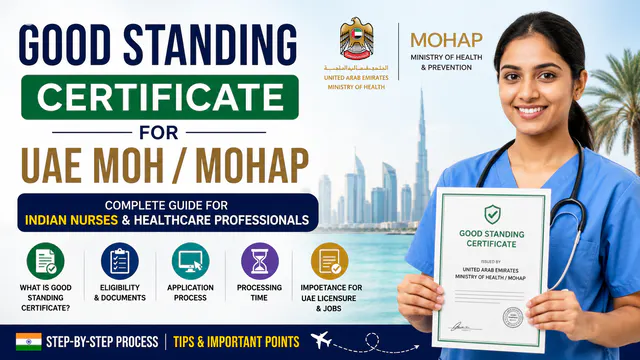
A good standing certificate (GSC) is an official letter issued by your nursing or medical council in India. It simply states that
- You are a registered professional with an active license
- Your registration has no complaints, disciplinary actions, or suspensions attached to it
- You are in good professional standing, meaning you are considered fit to practice.
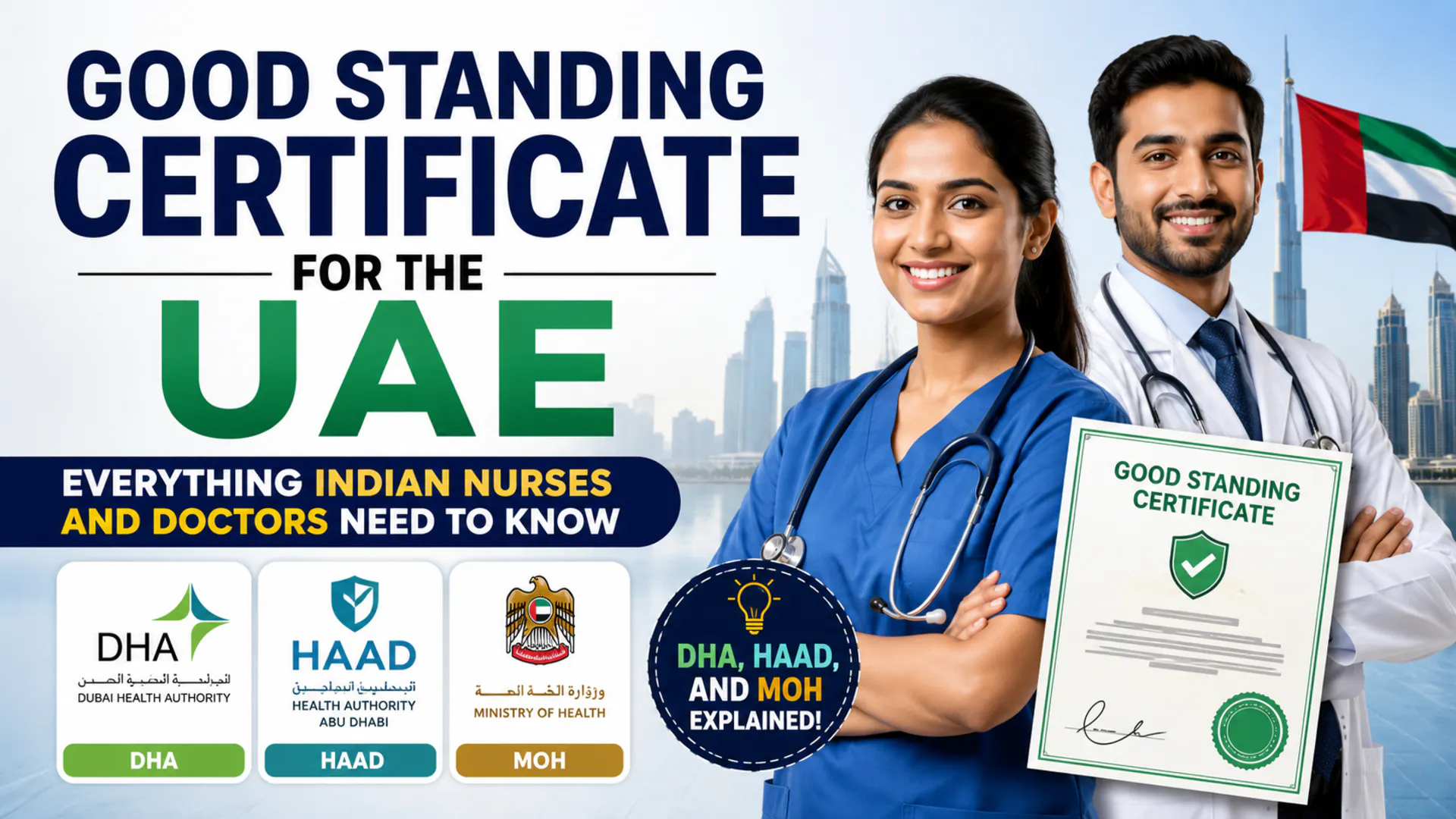
The UAE takes the quality of its healthcare workforce seriously. Whether you are applying to DHA in Dubai, HAAD in Abu Dhabi, or the UAE MOH for other emirates, they all require this certificate as part of your Dataflow primary source verification. It is not something you can skip or substitute.
Think of it this way: your qualifications tell them you are trained. Your good standing certificate tells them you are trustworthy.
DHA, HAAD, and UAE MOH—Which One Applies to You?
This is where a lot of nurses and doctors get confused. The UAE has three separate licensing bodies, depending on which emirate you are working in:
DHA — Dubai Health Authority. If your job is in Dubai—a hospital, clinic, or any healthcare facility inside Dubai—your license comes from DHA. Your good-standing certificate needs to be sent to DHA's Dataflow partner.
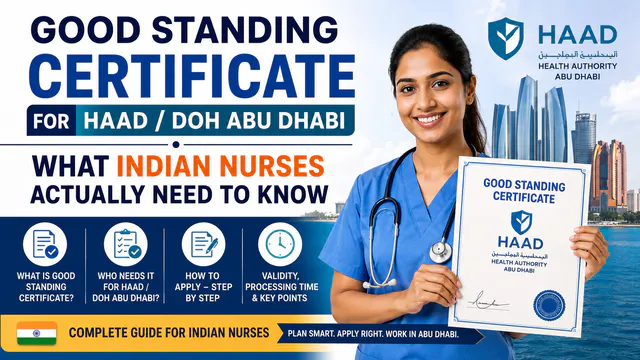
HAAD / DOH — Department of Health, Abu Dhabi. If you are working in Abu Dhabi, including hospitals under SEHA or private facilities, you fall under HAAD or DOH. Your good standing goes to their Dataflow system.
UAE MOH — Ministry of Health. If your job is in Sharjah, Ajman, Fujairah, Ras Al Khaimah, or Umm Al Quwain, you fall under the UAE MOH. Your good-standing certificate gets sent to the MOH's DataFlow process.
The good news is that the good-standing certificate itself is the same document regardless of which authority you are applying to. What changes is the recipient address where your council sends it. This is a small but critical detail. Getting the wrong address is one of the most common reasons applications get delayed.
Which Indian Council Issues Your Good Standing Certificate?
Your good standing certificate comes from whichever Indian council you are registered with, not from a government department or the UAE authority.
If you are a nurse from Kerala registered with KNMC, your GSC comes from KNMC. If you are a doctor registered with the Travancore Cochin Medical Council, it comes from TCMC. If you are a nurse from Tamil Nadu, it comes from the Tamil Nadu Nurses and Midwives Council.
Common councils that issue good standing certificates for UAE licensing:
- Kerala Nurses and Midwives Council (KNMC) — most common for nurses heading to the UAE
- Karnataka Nursing Council
- Tamil Nadu Nurses and Midwives Council
- Telangana Nursing Council
- Andhra Pradesh Nursing Council
- Maharashtra Nursing Council
- Delhi Nursing Council
- Travancore Cochin Medical Council (TCMC) — for doctors
- State dental and pharmacy councils — for dentists and pharmacists
One important rule: your council registration must be active and valid when you apply. An expired registration means the council cannot issue a GSC. There is no workaround for this.
What Documents Do You Need to Apply?
To apply for a good standing certificate for the UAE from your Indian council, you typically need:
- Your council registration certificate must be valid and not expired
- Passport copy — first and last pages, clear scans
- Passport-size photograph — recent one
- Authorization letter — addressed to your council, requesting them to send the GSC directly to the UAE authority
- Recipient details — the exact email address of DHA, HAAD, or UAE MOH's Dataflow desk
The authorization letter and the recipient address are the two things people most commonly get wrong. The recipient address, especially for DHA, HAAD, and MOH, each has different Dataflow partner contact details, and using the wrong one means the certificate lands in the wrong inbox or bounces entirely.
How the Application Process Works Step by Step
Here is how a good standing certificate application for the UAE works from start to finish:
Step 1 — Confirm your council registration is active. Log in to your council portal or check your registration certificate expiry date. If it has expired, renew it first — this is non-negotiable.
Step 2 — Find out which UAE authority you need: Dubai = DHA. Abu Dhabi = HAAD. Other Emirates = MOH. Confirm this with your employer or recruiter if you are unsure.
Step 3 — Prepare your documents. Gather your registration certificate, passport copy, photograph, and get the recipient Dataflow email ready for the correct UAE authority.
Step 4 — Write and submit the authorization letter. This is addressed to your council, requesting them to send the good standing certificate directly to the UAE Dataflow recipient. The format matters — councils may reject informal letters.
Step 5 — Submit to your council. Applications are usually submitted in person, by post, or through an authorized representative, depending on your council's process.
Step 6 — Wait for processing. Most councils take 15 to 30 working days. Some may take longer during peak periods. Regular follow-up with the council helps avoid your application sitting idle.
Step 7 — Certificate dispatched to UAE authority. Your council sends the certificate directly to DHA, HAAD, or MOH Dataflow. You will not receive the certificate yourself; it goes directly as part of your Dataflow file.
Common Mistakes That Delay or Reject Your Application
These are the mistakes that send applications back to zero, and they are almost all avoidable:
Wrong name on documents. Your name on the authorization letter, passport, and council records must all match exactly. Even a small difference in the middle name spelling variation can cause a mismatch that the council or Dataflow flags.
Expired council registration. Applying without checking your registration expiry date is the most common mistake. Always verify your status before initiating the process.
Wrong recipient address. Using DHA's address when you should be using HAAD's, or an outdated Dataflow email, means the certificate either goes to the wrong place or bounces. Councils do not automatically resend; you have to reapply.
Poor quality scans, blurry passport copies, or illegible registration certificates will be rejected by the council at the submission stage.
No follow-up after submission: Councils process hundreds of applications. Without regular follow-up, your application can sit in the queue longer than needed. Consistent communication speeds things up.
How Long Does It Take — Realistic Timeline
Here is what to realistically expect:
Stage | Typical Time |
Document preparation | 2 to 3 days |
Council processing | 15 to 30 working days |
Delivery to UAE Dataflow | 2 to 5 working days after processing |
Dataflow confirming receipt | 3 to 7 working days |
Total from start to Dataflow receipt: roughly 4 to 8 weeks if everything is correct from the first submission. Errors or resubmissions add significant time to this.
This is why getting the documents right at the first attempt matters so much, especially if you have a UAE visa timeline or a joining date to meet.
Does the Good Standing Certificate Expire?
Yes. Most UAE licensing authorities require the good-standing certificate to be issued within the last 3 to 6 months. A certificate that was issued more than 6 months ago may not be accepted by DHA, HAAD, or the UAE MOH as part of your current Dataflow application.
If your old GSC has expired, you will need to apply for a fresh one from your council. There is no way to extend an existing good-standing certificate; it has to be reissued.
Good Standing Certificate vs. Dataflow—Are They the Same Thing?
No, and this is something many people confuse.
Your good standing certificate is one document inside your Dataflow application. It is issued by your Indian council and confirms your professional standing.
Dataflow is a separate primary source verification process that the UAE requires for all healthcare professionals. It verifies your degree and experience certificates, and the good standing certificate is one of the items being verified inside Dataflow.
You need both. The good standing certificate feeds into Dataflow; it is not a replacement for it.
Can You Apply for Good Standing While Already Working Abroad?
Yes. If you are currently working in Saudi Arabia, Qatar, Bahrain, or anywhere else and planning to move to the UAE, you can still apply for a good-standing certificate from India. You do not have to physically be in India. You can send your documents digitally to a representative or agency that applies on your behalf, and the certificate gets sent directly from your council to the UAE authority.
Final Checklist Before You Apply
Before submitting your good-standing certificate application, go through this:
- ✅ Council registration is active and not expired
- ✅ Name on all documents matches passport exactly
- ✅ You know which UAE authority applies to your emirate: DHA / HAAD / MOH
- ✅ Correct the recipient Dataflow email address for that authority
- ✅ Authorization letter is in the correct format
- ✅ Passport copy is clear and legible
- ✅ Photograph is recent
If all seven are confirmed, your application is ready to submit.
Need Help Getting This Done?
Getting the good-standing certificate right requires knowing the exact recipient address for each UAE authority, the correct authorization letter format for each council, and consistent follow-up to avoid delays. A single wrong detail at the document stage can add weeks to your UAE licensing timeline.
Trueway International handles good-standing certificate applications for the UAE across all councils, including KNMC, Karnataka, Tamil Nadu, TCMC, and more. We also manage DHA, HAAD, and UAE MOH Dataflow in parallel, so both processes move together without unnecessary waiting.