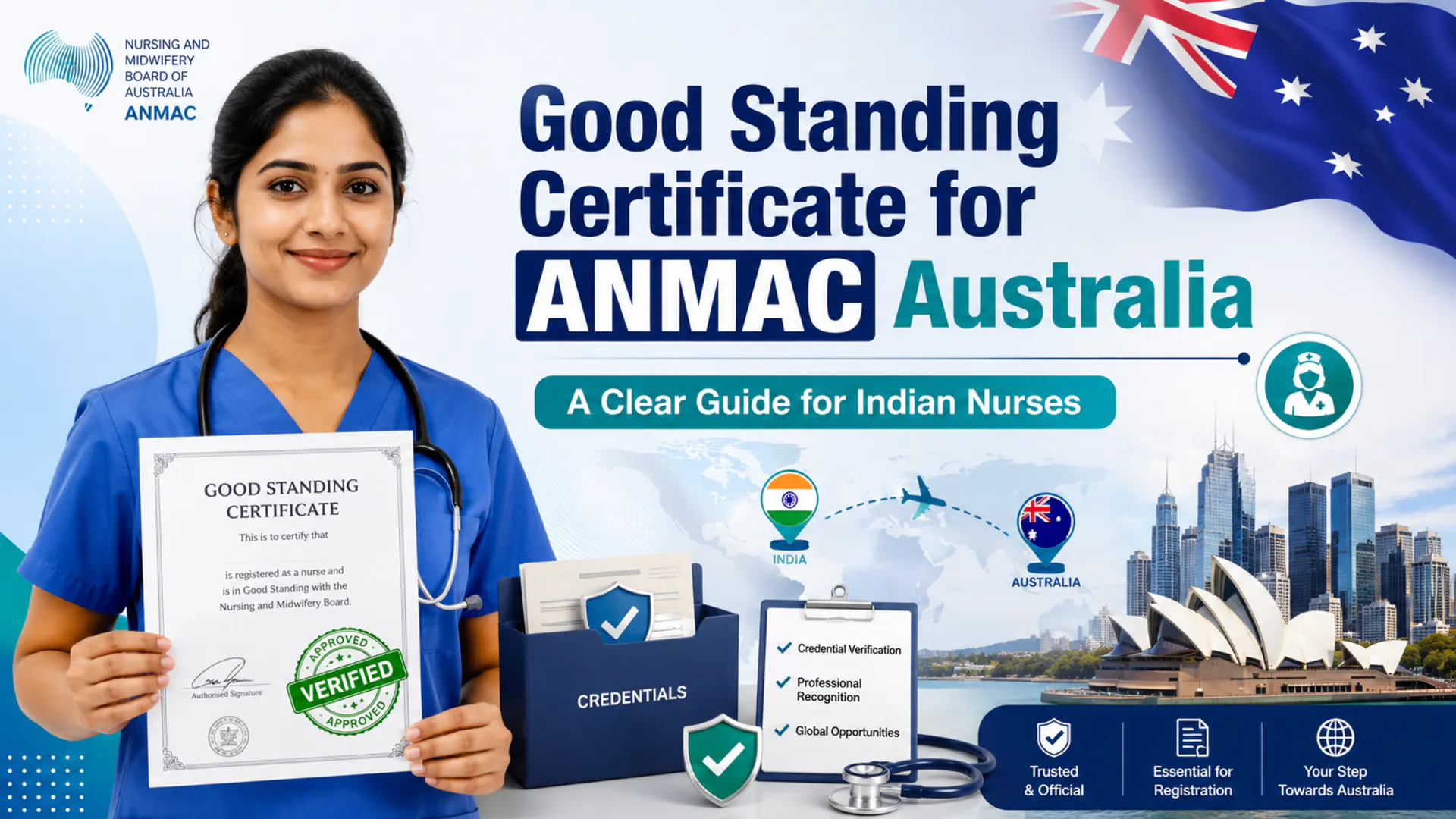
If you are planning to migrate to Australia as a nurse and someone told you that you need a "good standing certificate for ANMAC," you might have found yourself wondering what exactly that means, who issues it, and why ANMAC says you cannot submit it yourself.
This guide answers all of that. Whether you are researching Australian migration from India for the first time, or you are already working in the Gulf and planning your next move, or you have the ANMAC checklist in front of you and just need to know how to tick off this one document, everything you need is here.


















What Is ANMAC, and Why Does It Ask for a Good Standing Certificate?
ANMAC stands for the Australian Nursing and Midwifery Accreditation Council. It is a government-approved authority that assesses the qualifications and skills of internationally educated nurses and midwives who want to migrate to Australia through the General Skilled Migration program.
When you apply for a skilled visa to work in Australia as a nurse, whether that is subclass 189, 190, 491, or an employer-sponsored pathway, you need a positive ANMAC skills assessment first. This is the document that tells the Department of Home Affairs your nursing qualifications meet Australian standards.
As part of that assessment, ANMAC asks for a verification of your professional standing. They want to know that you are currently registered as a nurse in your home country and that no disciplinary actions or professional issues have been raised against you. The document that provides this confirmation is called a good standing certificate or a verification of registration.
Here is the part most nurses only find out after they start applying: ANMAC will not accept this document from you. It must come directly from your nursing council to ANMAC. You cannot scan it, courier it, or have your agent submit it on your behalf. The only acceptable route is to council ANMAC directly.
Where Does Your Good Standing Certificate Actually Come From?
Your good standing certificate comes from your registered nursing council in India, not from ANMAC or any Australian authority.
For most nurses from Kerala, that is the Kerala Nurses and Midwives Council. For nurses from Karnataka, it is the Karnataka Nursing Council. For Tamil Nadu nurses, it is the Tamil Nadu Nurses and Midwives Council. Each state's council is responsible for issuing the certificate for the nurses registered within it.
The council sends the certificate to ANMAC's office by post or email directly. You will typically receive a copy for your own records, but the original verification goes straight from the council to ANMAC.
ANMAC vs AHPRA — What Is the Difference?
This is one of the most common points of confusion for Indian nurses exploring Australia.
ANMAC assesses your qualifications for skilled migration purposes. It determines whether your nursing education and registration meet Australian professional standards. You need a positive ANMAC outcome to apply for most skilled migration visas as a nurse.
AHPRA, the Australian Health Practitioner Regulation Agency, is a separate body that handles your actual nursing registration once you are in Australia or applying for registration to work there. It is the Australian equivalent of the Indian Nursing Council.
The good standing certificate is a requirement for ANMAC for the skills assessment stage. It is a separate requirement that may come up again during AHPRA registration, but the ANMAC good standing certificate, specifically, is what this guide is about.
Two Types of ANMAC Skills Assessment — Which One Applies to You?
ANMAC offers different types of assessments depending on your situation, and the good standing certificate requirement appears in both.
The Full Skills Assessment is for nurses who are qualified and registered overseas but do not yet hold registration in Australia or New Zealand. Most Indian nurses applying from India fall into this category. This assessment requires a good standing certificate from every nursing council you have been registered with.
The Modified Skills Assessment is for nurses who already hold AHPRA registration in Australia or nursing registration in New Zealand. If you have already gone through AHPRA, the Modified Assessment is a faster route. The verification requirements differ slightly in this case.
If you are not sure which assessment applies to you, check with ANMAC or contact us, and we can advise based on your registration history.
The Critical Rule Most Nurses Miss
This is worth saying clearly because it causes so much delay.
ANMAC states in its own official requirements that the good standing certificate must be posted or emailed to ANMAC directly by the regulatory authority. They do not accept a photocopy, a fax, a scan, or a certified copy from the applicant or from an agent.
What this means practically is that you cannot receive the certificate from your council and then forward it to ANMAC yourself. The council must send it directly. This means the process needs to be set up correctly from the start, with a formal authorization letter from you to your council instructing them to send the certificate to the verified ANMAC address.
Getting this wrong by submitting a scanned copy yourself or using an outdated ANMAC address means ANMAC flags your application as incomplete and waits for the correct council-to-ANMAC submission. That delay, in a process that already takes 4 to 8 weeks after documents are received, can set you back significantly.
If You Are Already Working in Saudi Arabia, the UAE, or Another Gulf Country
This section is specifically for nurses currently working in the Gulf and planning to use Australia as their next destination.
ANMAC requires good standing from every country you have held nursing registration in — not just India. If you are currently registered as a nurse in Saudi Arabia under SCFHS, or in the UAE under DHA or HAAD, or in Qatar under QCHP, ANMAC will likely ask for a verification of registration from that authority as well.
This means you may need two separate good-standing certificates. One from the Indian Nursing Council, sent directly to ANMAC. And one from your current Gulf country's nursing authority, also sent directly to ANMAC.
This is a scenario many agencies do not prepare nurses for, and the result is that ANMAC receives the Indian certificate but puts the application on hold, waiting for the Gulf authority certificate. Knowing this upfront and arranging both at the same time saves weeks.
Trueway can advise on the good standing requirements from Gulf countries, depending on where you are currently registered, so you can approach ANMAC with everything in order.
Documents You Need to Apply
To apply for a good standing certificate for ANMAC from your Indian Nursing Council, you need these five things ready.
Your council registration certificate, which must be currently valid. If it has lapsed, you need to renew it before the certificate can be issued.
A clear passport copy covering the first and last pages. Your name on your passport must match your name on your council records exactly, including spelling, order of names, and middle name, because any inconsistency creates a problem both at the council submission stage and when ANMAC cross-checks documents.
A recent passport-size photograph.
The correct, current ANMAC recipient address. ANMAC has an email address where councils send good-standing certificates. This address is occasionally updated, and using an outdated one means the certificate goes nowhere. Always verify the current address before submission.
An authorization letter formally addressed to your council, requesting them to send your good-standing certificate directly to ANMAC. This letter needs to follow a specific format; informal or casually worded letters are returned by councils without processing.
Step-by-Step Process
Start by confirming all the nursing councils you have been registered with, both in India and in any other country. This determines how many good-standing certificates ANMAC needs.
Next, check that your Indian council registration is currently active and not expired. An expired registration means the council cannot issue the certificate.
Confirm the current ANMAC recipient address, not from an old guide or forum post but verified directly from the ANMAC website or from a trusted agency.
Prepare an authorization letter for each Indian council you are applying to. Each council needs a separate letter addressed to them, including your registration number with that specific council and the verified ANMAC recipient address.
Submit to your council, either in person, by post, or through an authorized representative, depending on what that council's process allows.
Follow up weekly after submission. Councils take 15 to 30 working days on average, and regular follow-up ensures your file does not sit longer than necessary.
Once the council dispatches the certificate to ANMAC, you receive a copy for your records. You can then proceed with your ANMAC online application in the Skilled Migrant Application Portal.
Where Good Standing Fits in the Full ANMAC Timeline
ANMAC recommends arranging your good standing certificate before you begin your online application. Here is why the timing matters.
When you open an ANMAC application online, the portal stays open for 12 months. Within that time, ANMAC expects all documents, including the council-submitted good standing certificate, to arrive. If you apply online and then wait 30 days for your council to send the certificate, those 30 days come out of your 12-month window and delay when ANMAC can begin its actual assessment.
The assessment itself, once all documents are received, takes 4 to 8 weeks. Your Outcome Letter, once issued, is valid for two years. After that, you lodge your Expression of Interest in SkillSelect and eventually receive an invitation to apply for your skilled visa.
Sorting the good standing certificate before or immediately alongside your ANMAC application is the simplest way to keep this entire timeline on track.
Common Mistakes to Avoid
Submitting a copy yourself is the most critical mistake. ANMAC explicitly requires the certificate to come directly from the regulatory authority. Any version submitted by you, your agent, or a third party will not be accepted.
Not knowing all the councils ANMAC needs is the second most common issue. Nurses who have registered in multiple states or worked in Gulf countries often focus on only one certificate and get their application flagged for the missing ones.
Name mismatches across documents are consistently flagged by both councils and ANMAC. Every document must show your name exactly as it appears on your passport.
Using an outdated ANMAC address is a silent mistake. The certificate goes out from your council to the wrong inbox, and you only find out when you chase ANMAC for an update.
Not following up with your council after submission means a standard 15-day process can stretch to 40 days simply because no one is pushing the file through the queue.
Final Checklist Before You Apply
List every council you have been registered with in India and in any other country. Confirm which ones ANMAC requires good standing from. Council registration is active and not expired. Name matches exactly across passport, council records, and authorization letter. Current ANMAC recipient address confirmed and verified. The authorization letter is correctly formatted for each council. Ready to follow up with the council weekly after submission.
If you are coming from a Gulf country, arrange or confirm the good-standing process with your Gulf authority as well.
All points confirmed — you are ready to begin.
Need Help Getting This Done?
The direct-from-council requirement, the multiple-council situation for Gulf-based nurses, and the importance of the correct current ANMAC address are the three things that make this harder than it looks on paper. Getting all three right from the first submission is what Trueway handles.
Trueway International processes ANMAC good-standing certificate applications from all major Indian nursing councils, including the KNMC, Karnataka Nursing Council, Tamil Nadu, Telangana, Delhi, Madhya Pradesh, and more. We also handle ANMAC and AHPRA council verification in parallel, so all parts of your ANMAC documentation move together.
See our ANMAC Good Standing Certificate service to get started.